Header

Objective Reviews & Commentary - An Engineer's Perspective
Showing posts with label Output Power. Show all posts

September 19, 2011

All About Gain

nwavguy gain diagramINTRO: For those interested in headphone amps, gain is an important topic. Here are the essentials about gain with lots of links to more information. In addition to this introduction explaining gain, there are later sections on:

RELATED ARTICLES: The following may be useful understanding how gain fits into the bigger picture:

WHAT IS GAIN? Put simply, gain is the maximum amount an amplifier can increase a signal. In the world of headphones, it's usually voltage gain. The diagram above shows a source with a weak output made 3 times stronger by an amplifier. Applying gain to a signal doesn’t normally change the dynamic range, it just makes everything louder. Other ways to specify gain, such as power and current, are rarely used for headphone gear.

YACA (Yet Another Car Analogy): The relationship between gain, volume, and maximum power can be confusing to some. Using car analogies might help:

  • Gain Is Like The Gear Selection - When a car is in its lowest gear its top speed is limited to a fairly low value but it can climb steep hills. It's somewhat the same with a headphone amp set to low gain. Think of a gain switch as 1st, 2nd, and 3rd gear on a car's transmission. Different gears are used for different driving conditions.
  • Volume is like the Throttle (Accelerator) - The volume control adjusts the overall power to the headphones much like the throttle in a car adjusts the power to the wheels.
  • Maximum Power is like Top Speed - Most cars are capable of going faster than most people need. While a car might have a top speed of 100 MPH, in first gear, it might only do 40 MPH. So gain can be used as a way to limit maximum output and better match the output to a given pair of headphones. The difference between the top speed and the highest speed limit is somewhat analogous to excess gain.

WHY DOES GAIN MATTER? If you don't have enough gain, your headphones probably won’t get loud enough. If you have too much gain, you will be forced to use only a small portion of the volume control's range, there may be increased channel balance problems, more noise, more distortion, and you could even damage your headphones more easily. Most any amp will perform worse at higher gain settings so you want to use the least amount of gain that gets the job done.

GAIN AND VOLUME ARE IMPLEMENTED DIFFERENTLY: Turning down the volume is not the same as lowering the maximum gain (with a few rare exceptions). A race car doesn't turn into a family car if you never use more than half throttle. Certain compromises were made in the race car that make it less suitable for family car duty even if you try to drive it slowly. The same is true with a high gain amp. It's important to not have much more gain than you really need.

GAIN CAN BE USED TO LIMIT MAXIMUM POWER: If you have some fairly efficient headphones that are as loud as you would ever want with only 0.7 volts of audio. But you have a high-end desktop headphone amp that can put out 10 times as much (7 volts). By reducing the gain, even if you accidentally turn the volume all the way up, you can limit the maximum power to your headphones. This can help prevent hearing damage and even headphone damage. It also also allows using much more of the volume control's range making volume adjustments easier and more accurate.

GAIN CAN CHANGE WITH DIFFERENT HEADPHONE LOADS: If an amp doesn’t have an output impedance below 2 ohms the gain will change with different loads. The higher the output impedance, the more dramatic the change. For example, an amp with a 120 ohm output impedance with 5X gain at no load, will have only 3.5X gain with 300 ohm headphones and only 0.6X gain with 16 ohm headphones. This is another reason it’s important to know the output impedance.

GAIN CANNOT CORRECT FOR A LACK OF MAXIMUM POWER: If your headphones need 5 volts but your amp is only good for 2 volts cranking up the gain won't help any and will just make the amp clip sooner. Clipping is what happens when an amp runs out of power. The rest of this article assumes your amp is capable of enough power for your headphones. For more on this topic see: More Power?


GAIN DETAILS

HOW IS GAIN EXPRESSED? Gain is usually expressed as a factor (ratio), such as 4X, or in decibels (dB) such as 12 dB. In this case, 4X is the same as 12 dB and simply means with the volume control set to maximum, the output voltage of the amplifier will be four times higher than the input voltage. If you put 1 volt in you will get 4 volts out (assuming you don't exceed the maximum output capability). I show how to convert from ratios to dB and back in the Gain Calculations section below.

WHAT ARE TYPICAL GAINS? Headphone amps that have just a single fixed gain typically range from 2X (6 dB) to 5X (14 dB). For amps with two gain settings, low gain might be 2X to 3X and high gain 5X to 8X. Some amps have three or more gain options while others allow changing internal jumpers or resistors to set the gain.

A ROUGH GUIDELINE: If you want to skip the more technical details, the table below offers some idea of what gain will be usable with various headphones and sources:

Headphones Portable USB DAC HOME < Source
IEM 100 - 115 dB/mW 16 - 32 ohms 1X/0 dB 1X/0 dB 1X/0 dB  
Sensitive Low Impedance Full Size Grado, Denon, Etc. 2X/6 dB 1X/0 dB 1X/0 dB  
Average Full Size HD5xx/600/650 100 - 300 ohm 5X/14 dB 3X/10 dB 2X/6 dB  
High Impedance Full size 300 - 600 ohm 10X/20 dB 5X/14 dB 3X/10 dB  

DO I NEED AN AMP AT ALL? If your headphones already get plenty loud enough, and you're happy with the sound, odds are you don't need an amp. But if they don't get loud enough, an amp may be required. The table above shows several combinations where the gain is listed as 1X which implies no amp is required. But you might still want to use an amp to lower the output impedance of your source. For example, the iPod Touch 3G has a 7 ohm output impedance. With balanced armature IEM headphones this causes audible problems. See: Output Impedance. So while the IEMs don't need any more voltage they can still benefit from a lower output impedance. Some amps, like the O2, can be easily configured for 1X gain and improve the sound of higher impedance sources. For more on headphone amps in general, see: Headphone Amps Explained


EXCESS GAIN

EXCESS GAIN: If your amp has just enough gain for your headphones to hit the desired level at full volume with a 0 dBFS signal it's sort of like having a car with a top speed equal to the highest speed limit in your area. There might be times when you want to go even faster. But how much extra do you need? The amount of volume control range above where a 0 dBFS signal clips is considered “excess gain”. Here are some points to consider:

  • Excess Gain Is A Tradeoff - As described above in Why Does Gain Matter, too much gain has negative side effects. So it's a tradeoff between those side effects and how much excess gain you want.
  • Excess Gain Is Only Useful For Quiet Tracks - Most properly recorded digital music is designed to hit, or get within 1 dB of, 0 dBFS. If your amp has excess gain, using full volume with normal tracks will cause the amp to clip (badly distort) and may even damage your headphones. But, without excess gain, rare quiet tracks may not be loud enough even with the volume at 100%. One solution is having a reasonable amount of excess gain. Another solution is to normalize quiet tracks to 0 dBFS using Audacity or other software. This simply raises the levels so the loudest portion of the track is at 0 dBFS. Yet another solution is to use ReplayGain which helps equalize all tracks to roughly the same perceived volume. 
  • ReplayGain (volume leveling) - If you use something like ReplayGain nearly all of your music should play at a consistent subjective level. ReplayGain is essentially like having someone automatically adjust the volume for each track (or CD). The default target loudness of 89 dB leaves 14 dB of headroom between the average volume and 0 dBFS. For the most compressed pop music this means the peak levels will be as much as 6 dB below 0 dBFS, while dynamic music will get much closer to, or even hit, 0 dBFS. If you use ReplayGain, or something similar, for volume leveling, you may want up to 6 dB of excess gain to allow for the overall volume reduction ReplayGain applies to some tracks. For more on average volume see: More Power?
  • Dynamic Range – It’s important to note that neither the gain of an amplifier, nor ReplayGain, normally changes the dynamic range of music. Gain changes normally apply equally to the softest and loudest portions of the signal (music). To change the dynamic range you have to apply compression, limiting, (or dynamic range expansion).
  • Clipping vs Maximum SPL – Some amps have plenty of power and your headphones, or ears, will give up before the amp does when dialing up excess gain on a recording that already hits 0 dBFS. But, in some circumstances (especially with low sensitivity headphones), the amp might run out of power first. If you want to be assured your amp will never clip, just work backwards from the amp’s maximum output into your headphone impedance to determine the gain. If your amp maxes out at 7 volts, and your source is 2 volts, set the gain to 3.5X and the amp will never clip even at full volume with a worst case recording.  See: More Power?
  • 9 dB Excess Gain Is A Reasonable Maximum - I would aim for at least 3 dB of extra gain but somewhere around 9 dB the negative side effects already mentioned start to outweigh the advantages. A few might want to go as high as 12 dB but only if they've used something like ReplayGain to normalize their music library to a lower than normal average volume or have other unusual requirements.
  • The Math – 3 dB of extra gain means multiplying the minimum gain by 1.4 and for 6 dB multiply by 2, and for 9 dB multiply by 2.8.

THE CHANNEL BALANCE PROBLEM: Devices with conventional volume controls may have audible channel imbalance at very low volumes. It's extremely difficult to manufacture volume control potentiometers that maintain tight channel balance below about -40 dB (referenced to full volume). Having too much excess gain forces using only the lower portion of the volume control's range with normal recordings. If your amp has 10 dB of excess gain, for example, -40 dB below 0 dBFS on the volume control is -50 dB below full volume. The channel balance error will likely be much greater and more audible. Some products get around this problem by using digitally controlled electronic volume controls that can maintain better channel balance at low settings but these can add distortion and often controlled by up/down buttons rather than a simple knob. Stepped precision attenuators are another solution but are expensive and sometimes their step size is too great.


GAIN CALCULATIONS

HOW DO YOU CONVERT FROM Gain Ratio X TO dB? The math requires using a function known as base 10 logarithm (LOG on a calculator). But you can also just use an online dB calculator:

  • Online dB Calculator
  • Gain in dB = 20 * LOG10 ( Gain Factor ) [i.e. 20 * LOG10 ( 4 ) = 12 dB]
  • Gain Factor = ANTILOG10 ( Gain in dB / 20 ) [i.e. ANTILOG10 ( 12 / 20 ) = 4X]

HOW MUCH GAIN DO I NEED? This comes down to only three things:

  • How much voltage your headphones need
  • How much output your source has
  • How much excess gain you want.

HEADPHONE REQUIREMENTS: For a given pair of headphones, the More Power? article helps determine what your headphones need. This is related to the sensitivity and impedance of your headphones which vary widely. The most efficient IEMs only need about 0.1 volts to play loudly, Sennheiser HD600s need about 2.3 volts and Beyer DT880-600s need about 6 volts or 60 times more than the IEMs.

SOURCE OUTPUT LEVEL: Sources have a maximum output level. It's the output voltage at 0 dBFS (the loudest digital music can get) and at full volume (if the source has a volume control). Sources can be roughly divided into the follow categories (all voltages are Vrms):

  • Portable Players - Most of these have a maximum output of 0.5 - 1.0 volts from either their headphone jacks or LOD (Line Output Dock) connectors. The iPod Touch is 0.5 volts from the LOD.
  • USB Powered DACs - Most of these have a maximum output of 1.5 volts or less.
  • Normal Home Audio Gear - The Redbook standard for any home equipment that plays digital audio is 2 volts. Some go slightly higher up to 2.5 volts. There are also a few USB powered DACs that can manage similar voltages (such as the HRT Music Streamer II).
  • Unusual (rare) Home Sources - A few companies, arguably unwisely, have decided to go well above the established standard and output more than 2.5 volts. But I'm not aware of any that go above 3.3 volts unless they have a volume control.
  • Balanced Outputs - These can be misleading because balanced outputs normally have twice the output of unbalanced outputs. A 4 volt balanced output, used with an unbalanced adapter or cable, is really only 2 volts.
  • Unknown Sources – See DIY Gain Measurements below.

CALCULATING THE REQUIRED GAIN: Once you've figured out the above three requirements, it's fairly easy to calculate the gain you need. Just follow these steps (examples are given for the HD600's driven from an iPod LOD with 3 dB excess gain):

  • Calculate Minimum Gain: Gain Factor = Vout / Vin [i.e. 2.3Vout with 0.5V Vin = 2.3/0.5 = 4.6X]
  • Convert To dB: Minimum Gain in dB = 20*LOG( Gain Factor ) [i.e. 20*LOG(4.6) = 13.2 dB]
  • Add Excess Gain: Final Gain in dB = Minimum Gain + Excess Gain [i.e. 13.2 + 3 = 16.2 dB]
  • The result is 16.2 dB (6.5X) of gain for the example case.
  • You can also multiply 4.6X by 1.4 to get 6.5X (1.4 is 3 dB excess gain as a ratio)
  • If you know the output impedance multiply by (Zload + Zout) / Zload

INPUT OVERLOAD: Also be aware that many devices, especially portable ones, have inputs that can be overloaded by certain sources. Because the Redbook standard is 2 volts, a lot of devices are designed to only handle about 2.1 volts such as the FiiO E9 desktop amp. And the portable FiiO E7 overloads at about 1.2 volts on the input because it was designed for use with portable players which are generally under 1 volt. Sometimes the input overload point may depend on the gain settings. So check the documentation for a given amp--especially if you plan to use home sources with a portable amp, or sources with more than 2 volts of output.

nwavguy gain resistors diagramRESISTOR VALUES: Some amplifiers let you set the gain by changing resistor values. The diagram to the right shows a typical non-inverting amplifier stage. The gain is given by 1 + 1000/500 = 3. For all the math, see Wikipedia Gain and Wikipedia Amplifiers. Some amplifiers may have multiple gain stages, in which case you have to multiply the gain of each stage together. So an amp with a 2X and 3X stage has a total gain of 6X.

DIY GAIN MEASUREMENTS: If you have a decent DMM (multimeter) that can measure x.xx volts AC (i.e. 0.01 volt resolution) you can play back a 60hz 0 dBFS sine wave and measure the output of your source in Vrms. You can create the file with Audacity. Ideally the voltage should be measured using a “Y” cable with your source connected to the amplifier. You can then also (carefully so not to cause short circuits) measure the output of your amplifier. Don’t connect your headphone as they could be damaged. And don’t try higher frequencies as most meters are not accurate much above 60 hz. Vout/Vin = Gain

BOTTOM LINE: Gain is important. There's a definite sweet spot for most headphones and sources. The closer an amp comes to having the ideal gain, the better overall performance you will get.

September 2, 2011

More Power?

volume knob mikael altemarkINTRO: While the plugs on most headphones are compatible with the jacks on most gear that doesn’t mean the two will play nice together. Headphones vary widely in their power and drive requirements and some sources are far more capable than others. Mismatches are common. If you’re not satisfied with what you have now, or you’re shopping for new gear, this article might be worth checking out. (photo: Mikael Altemark).

THE PROBLEM: Put simply, a lot of headphones are not well suited for a lot of sources and vice-versa. There’s more involved than just using headphones with the right impedance. One of the most important things to consider is the sensitivity (efficiency) of the headphones.

THE EASY WAY (ROUGH ESTIMATE): If the sensitivity of your headphones is listed in dB/mW you can get a rough idea how much amplifier power is needed with the following table. To use the table, find your headphone’s sensitivity in the left column (use the next lowest number if it’s between two numbers). Then look at the numbers in the next 3 columns. Most should use a peak SPL of 110 dB (the middle column). But if you don’t like loud music, or listen to mostly pop music, you might be happy with 105 dB. If you like it really loud, or listen to a lot of audiophile recordings, use 115 dB.  For example, the Sennheiser HD600 is 97 dB/mW so it requires 20 mW to hit peaks of 110 dB. The tricky part is your source needs to produce at least that much power at the impedance of your headphones and some manufactures don’t do a good job specifying power output. More on that in the Tech Section. You can also use the table in reverse to look up a source’s output power and see how that might match up to different headphones.

dB/mW 105 110 115 < Peak SPL
85 100.0 316.2 1000.0  
88 50.1 158.5 501.2  
91 25.1 79.4 251.2  
94 12.6 39.8 125.9  
97 6.3 20.0 63.1  
100 3.2 10.0 31.6  
103 1.6 5.0 15.8  
106 0.8 2.5 7.9  
109 0.4 1.3 4.0  
112 0.2 0.6 2.0  
115 0.1 0.3 1.0  
118 0.1 0.2 0.5  

SPECIFICATIONS DO MATTER: If you ask a lot of the audiophile manufactures why they don’t offer more complete specs for their products they often counter with something like: “specs don’t really matter”. But in this case they very much do matter. Headphones playing loudly enough with a particular source isn’t magic or something that can only be determined by trial and error. It’s entirely determined by a few numbers and some relatively simple math. It’s not like all headphone sources work well with nearly any headphones. It’s very much the opposite—compatibility problems are widespread. So the next time you hear “specs don’t matter” consider that person either mis-informed or they’re intentionally trying to mislead you.

MAXIMUM POWER vs GAIN: A headphone amp needs both enough maximum power and also enough gain to reach that power level with a given source. Sources vary widely in their output. An iPod Touch line output (LOD) only produces a maximum of 0.5 volts while most home gear has at least four times more output. So just because your amp has enough power you also need to make sure it has enough gain. See: All About Gain

POWER REQUIREMENTS vs POWER HANDLING: There’s often a big difference the amount of power headphones need to play loudly enough versus the maximum power the manufacture claims they can handle. When you see a specification that says something like “Maximum Power: 200 mW” that doesn’t mean you need, or even want, 200 mW. It only means if you use much more than 200 mW you might damage the headphones.

FIVE FACTORS: If you want know everything that goes into determining headphone and source compatibility there are five things to consider:

  • Type Of Music (average volume) – Music varies widely in its average volume. Heavily compressed pop music has a much higher volume than say an audiophile jazz recording.
  • Desired Maximum Output – This is simply the maximum perceived volume someone wants to listen at. It varies from person to person but it can be estimated fairly accurately several different ways.
  • Headphone Sensitivity – This is how loud the headphones will play for a given power or voltage level (from the specs or professional measurements).
  • Headphone Impedance – This makes a big difference in the next item and is necessary for some conversions. This is nearly always in the headphone specs.
  • Source Maximum Output – This is how much power the source can produce which varies depending on the impedance of the headphones. This is often poorly specified but it is measured in proper product reviews with full measurements. You can sometimes make assumptions from what specs are provided.

Lady Gaga Just Dance Exactly As Ripped From The CD

AVERAGE (RMS) VOLUME: Music varies widely in average volume (also known as “RMS volume”) which roughly equates to the perceived loudness of the music. Somewhere around the early 90’s the “loudness wars” started. Recording engineers starting using more and more compression (which boosts the soft parts of music) so their mix sounded louder than other mixes. As a result, over the last two decades, the average volume of pop music has slowly risen dramatically. With digital recordings the loudest anything can be is 0 dBFS where the “FS” means Full Scale. This sets the maximum peak levels on the recording. Average volume is measured in dB below 0 dBFS and here’s a rough guide:

  • Highly Compressed Pop (see pic above right): –6 dB to –9 dB
  • Well Recorded Pop: –9 dB to –12 dB
  • Well Recorded Acoustic/Jazz: –12 dB to –18 dB
  • Wide Dynamic Range Classical: –18 dB to –30 dB

WHAT’S RMS? RMS is just a geeky way to, for the purposes of this discussion, describe the average level of a waveform. It’s roughly 1/3 the peak-to-peak value of a sine wave. For something as complex as music, the RMS value is much more complicated but still can be calculated by software analysis and measured by more sophisticated instruments.

WHY AVERAGE VOLUME MATTERS: If you include the extremes there’s a range of roughly 24 dB in average volume between different kinds of music. How much is 24 dB? If we take highly compressed pop recording and play it at given average volume a highly dynamic classical recording might require 250 times more peak power! This isn’t strictly a fair comparison as if you really tried to play the classic recording at that level you would likely be reaching for the volume control during the louder parts. But it illustrates how important the source material is in determining peak power requirements.

audacity flim and the bbs - new americaDIFFICULT MUSIC: The most challenging music is where the average volume is always relatively low prompting you to turn up the volume but there are very brief transients that are far higher in level. This is most common in audiophile recordings where very little or no compression is used and there are Sforzando (brief loud) notes in the music. This is very different than say symphonic classical music that builds up to fairly high sustained average levels  (i.e. crescendos) that will have you turning down the volume. Brief loud transients add impact to the music without making it seem much louder. Worst case, these brief transients can be 20+ dB above the average level requiring around 100 times more power than the average level. Compare the Flim and the BB’s – New America track in Audacity to the Lada Gaga – Just Dance track (the two screen shots above). Even during the “loud” part of New America the average level (light blue portion) is still relatively low.

clipping fiio vs o2 scope traceCLIPPING: When the source doesn’t have enough voltage and/or current to meet the peak demands of the music it clips off the peaks. Studies have shown it may go unnoticed if it’s infrequent and mild. But if it happens often, or a single event is severe, it tends to be plainly audible as a harsh “grunge”. It’s the number one cause of plainly audible distortion in everything from cell phones to car stereos. In the waveform shown to the right the yellow trace is properly reproduced while the green trace is from a less capable amp and you can see what happens to the peaks in the music—they’re “clipped” off as if someone took scissors to the music.

DESIRED MAXIMUM VOLUME: So how loud is “loud enough”? To establish the upper end of subjective tastes, studies show the threshold of pain starts around 120 dB SPL. It seems reasonable to use that as the absolute upper limit. 120 dB SPL is also the level at which even short term exposure can cause permanent hearing impairment. Studies have shown even sustained average levels above 85 dB SPL can cause hearing damage. For more on these thresholds see Sound Pressure Levels. The research indicates the average maximum level should be at least 85 dB, and with classical music, that puts the peak level up to 30 dB higher at a worst case 115 dB). For more typical music peak levels of 110 dB SPL are more reasonable.

LIVE MUSIC: If you monitor sound pressure levels during live performances, rock concerts typically average 110 dB with peaks of 115 dB to 120 dB. Classical performances typically have peaks hitting 110 dB and a much lower average level of around 90 dB or less.

hd650-pop-music-max-SPLTESTING THE THEORY WITH POP MUSIC: I used my non-fatiguing HD650 headphones plugged into my O2 amplifier, and played several different selections of fairly well recorded pop music at levels as loud as I would ever want to listen—likely into hearing damage territory for any sort of sustained or cumulative listening. The HD650 needed about 1.7 – 1.8 Vrms which works about to about 107 dB SPL. The oscilloscope screenshot to the right (click for larger) shows the music and the the horizontal dashed lines are the peak-to-peak value (about 4.8V). Notice the marked peak isn’t all that far above the rest of the music. For this kind of music, and my subjective idea of what’s “too loud”, I’m close to the 110 dB SPL guideline established above. So far the guideline is holding up well.

hd650-highly-dynamic-music-max-SPLTESTING WITH FLIM & THE BB’s: Next I repeated the above test but this time using the same Flim & the BB’s – New America track shown earlier. I set the volume to where the loudest parts of the track were about at my limit of still being “comfortable”. Now the peaks hit 5.1 volts in one direction or about 10.2 volt peak-to-peak (the sample in this case is about 9 V p-p). That’s about 3.2 – 3.6 Vrms which is about 114 dB from the HD650’s on the peaks. This at the limit of or beyond what most portable amps can manage (the O2 being a notable exception). This correlates well with the 115 dB rule of thumb for highly dynamic music. So, working backwards from the threshold of pain and hearing loss you get 105 – 115 dB. Using live performance levels you get 105 – 115 dB. And testing using my own music, ears, and headphones, I get 107 – 114 dB SPL. So, all things considered, 110 dB SPL seems like a good target if you want to pick just one number. Add 5 dB for really wide dynamic range music at live levels and subtract 5 dB if you listen to mostly Lady Gaga or don’t like it very loud.

HEADPHONE SENSITIVITY: Headphones need widely different amounts of power to play at the same loudness. How loud they get with a given amount of power is their Sensitivity or Efficiency. This number is properly specified as either dB SPL per milliwatt (1/1000 of a watt) or as dB SPL per volt. The older international standard used the milliwatt method and the newer method uses voltage. But sometimes manufactures don’t specify either in their specs—such as Ultrasone in the list below. The list shows a range of 87 dB to 117 dB at the same 1 mW of power. That’s 30 dB and, believe it or not, the HiFiMAN headphones need 1000 times more power to play at the same level as the TripleFi 10s!  Some examples:

HEADPHONE IMPEDANCE: The impedance is listed at the end of the specs for each of the above headphones. It’s important to know the impedance if you want to convert between watts and volts—to say compare the HD600 to the HD650’s sensitivity. It’s also essential to estimate how much output a given source will have using a particular pair of headphones. Impedance is specified in ohms (Ω).

SOURCE MAXIMUM OUTPUT: This is where things often get vague. A lot of sources, including portable players, headphone DACs, and headphone amps, have incomplete output power specifications. The output power of any device is very dependent on the impedance of the headphones (known as the “load”). Power is a function of voltage and current. And, unfortunately, different sources have differing maximum amounts of both. Some, like Apple, keep it all a secret while others, like Sony, specify a useless value. The output impedance of the source (which is rarely specified) also alters the maximum power into different loads. So without complete specs it can be difficult to estimate. Here are some typical examples:

  • Apple iPod Touch – Power not specified, output impedance not specified
  • Sony NWZS545 – Audio Power Output: 5mW + 5mW (useless!), output impedance not specified
  • NuForce uDAC-2 - Power output: 80mW x 2 @ 16-Ohm, output impedance not specified
  • FiiO E7 – Output power: 150mW (16 Ohm); 16mW (300 Ohm), output impedance not specified
  • FiiO E9 - Output power: 1W (16Ω); 80mW (600Ω), output impedance not specified
  • Leckerton UHA-4 - 20mW 16 ohms, 40mW 32 ohms, 50mW 100 ohms, 15mW 300 ohms, output impedance 0.4 ohms

HEADROOM: The 105 – 115 dB guideline established above works fairly well without any extra headroom. But audio purists might want to add another 25% – 100% (1 – 3 dB) more power for a bit of extra headroom so the amp is even less likely to clip any peaks.

SUMMARY: The table at the start of this article can be used to get in the ball park and I’ve tried to explain how average volume and preferences also make a big difference. The more technically inclined may want to keep reading and learn how to calculate volume levels, convert between different specs, and more.


TECH SECTION (math ahead)


PERFECT SOURCES: As shown earlier, headphone and source specifications range from non-existent to fairly complete. Some headphone sources behave as a perfect voltage source. That means they will always produce the same output voltage no matter what reasonable load you connect. Even a headphone amp such as the $20 FiiO E5 can produce the same 1.2 Vrms into any load from 16 ohms (about as low as headphones go) to 600 ohms (the common upper limit). As long as you don’t need more than 1.2 V, it does a pretty good imitation of a perfect voltage source. This is because it has a low output impedance and enough current to drive 16 ohm loads without current limiting. With such a source the max power output is given by:

  • P = (Vmax * Vmax) / Headphone Impedance

POWER EXAMPLES: For low impedance sources that have ample current available, such as the FiiO E5, here’s the same amp with 3 different headphones, note the widely different power outputs:

  • HD600 (300 ohms) & FiiO E5 – (1.2 * 1.2)/300 = 4.8 mW
  • Beyer DT770 (80 ohms) & FiiO E5 - (1.2 * 1.2)/80 = 18 mW
  • TripleFi 10 (32 ohms) & FiiO E5 - (1.2 * 1.2)/32 = 45 mW

IMPERFECT SOURCES: In this case “imperfect” doesn’t necessarily mean bad, but several factors can limit the output of a given source. Any source can only manage so much voltage even with no load at all. It’s limited by the internal power supply voltage, and with most portable battery powered gear, is often relatively low. Most iPods can only manage about 0.5 – 1.0 Vrms maximum voltage, the FiiO E7 1.2 Vrms and the Leckerton UHA-4 about 2.2 Vrms into the highest impedance headphones (600 ohms). As the impedance drops, instead of the voltage staying the same, the voltage also may drop. This can be due to a significant output impedance and/or reaching the internal current limits (current limiting).

OUTPUT IMPEDANCE: Headphone sources have output impedances ranging from less than 1 ohm to 120 ohms or more. As the output impedance gets within about 1/8th of the headphone impedance it starts to significantly decrease the output available. The output impedance creates a voltage divider with the headphones.  It’s no longer close to being a perfect source as explained above. If an amp has a 50 ohm output impedance, and you plug in 50 ohm headphones, only one quarter as much power is delivered to the headphones compared with a zero ohm output impedance.

CURRENT LIMITING: Look at the specs for the Leckerton UHA-4 above. It puts out 50 mW at 100 ohms and that works out to 2.2 Vrms. If it could manage the same 2.2 Vrms into 16 ohms it should put out (2.2 * 2.2)/16 = 302 mW. but Leckerton only lists 20 mW. It has an output impedance of only 0.4 ohms so that’s not the problem. So what’s going on? The answer is some sources run out of current as the load impedance drops below some value. That’s what’s happening with the UHA-4. It just doesn’t have the beans to maintain the same voltage into loads much below 100 ohms. If a manufacture doesn’t specify the power output over a wide range of impedances it’s impossible to predict this behavior. Some might be tempted to argue that low impedance headphones are much more sensitive and need less power so this doesn’t matter, but that’s not always true. The HiFiMAN headphones above, many of the AKG models, and others, have low impedances and relatively low sensitivities. And they would be a poor match with something like the Leckerton.

CONNECTING THE DOTS: If a company doesn’t specify the power output around your headphone impedance you’re forced to try one of the following:

  • Power Specified At A Lower Impedance – In this case you want to figure out the voltage at the lower impedance and use that instead. The math is V = SquareRoot( Power in Watts * Impedance ). So for the FiiO E7, for example, it’s SquareRoot ( 0.15 * 16 )  = 1.5 Vrms.
  • Power Specified At A Higher Impedance – It’s impossible to accurately predict a source’s behavior into impedances lower than specified when you don’t know the output impedance or maximum current. The Leckerton UHA-4 example above shows how it goes wrong with current limiting. And the E9 shows how it goes wrong due to its higher (10 ohm) output impedance. The E9’s 80 mW into 600 ohms gives: SquareRoot ( 0.080 * 600 ) = 6.9 Vrms which should yield 3 watts at 16 ohms, but the E9 only manages 1 watt or 4 Vrms because a lot of power is lost due to the 10 ohm output impedance. A very rough estimate can be obtained by calculating the voltage at the next higher impedance, and then dividing that value by four to calculate power at lower impedances.
  • To Many Unknowns If you don’t know a device’s output into an impedance at least as low as your headphones, I would strongly suggesting choosing a different source with better specified output power (or voltage). Generally manufactures that don’t offer complete specs likely are trying to hide something or they many not even know themselves. Their potential customers should not be forced to guess if their gear will meet their needs. A better specified product is a much safer investment.

BRINGING IT ALL TOGETHER: If your eyes haven’t glazed over yet, it’s time to bring all of the above together. That involves converting between volts, power and decibels.

LOGARITHMS: Don’t panic, but the math involved requires a button that might not be on your calculator usually labeled “LOG” (base 10 logarithms are known as LOG10 in spreadsheets) and the inverse usually labeled “10x” (base 10 antilog or POWER(10,value) in spreadsheets). There are some online logarithm calculators that can also help with the math.

CALCULATE SPL FROM POWER: If you have a given source, and want to know how loud your headphones will get, you need to know the sensitivity of your headphones in dB/mW and the output power of the source in mW at the headphone impedance. Here’s the equation and the the FiiO E5 driving the HD600s (from above):

  • dBSPL = Sensitivity in dB/mW + 10 * LOG ( Pmax in mW)
  • 97 + 10 * LOG ( 5.6 ) = 103.8 peak dB SPL for HD600 & FiiO E5

CALCULATE SPL FROM VOLTAGE: If you know the voltage of your source at your headphone impedance, and your headphones sensitivity is rated at 1 volt, you can calculate the maximum output using the FiiO E5 and the HD650:

  • dB SPL = Sensitivity in dB/volt + 20 * LOG ( Vmax)
  • 103 + 20 * LOG ( 1.2 ) = 104.6 peak dB SPL for HD650 & FiiO E5

HOW LOUD WILL IT BE? The rule of thumb established above is 110 dB SPL for peak levels with a reasonable range of 105 – 115 dB depending on music and preferences. The E5 obviously falls a bit short with either the HD600 or the HD650 but it might still get loud enough for some tastes—especially with heavily compressed pop music with a high average volume. So let’s work the numbers the other way and see how much power the same headphones ideally need.

CALCULATE POWER FROM SPL: Using the HD600, rated in dB/mW you get:

  • Power in mW = Antilog ( ( Desired SPL - SPL at 1 mW ) / 10 )
  • Antilog ( ( 110 - 97 ) / 10 ) = 20 mW for HD600 to hit 110 dB SPL peak
  • Antilog ( ( 115 - 97 ) / 10 ) = 63 mW for HD600 to hit 115 dB SPL peak

CALCULATE VOLTAGE FROM SPL: As above except for the HD650 rates in volts we get:

  • Voltage RMS = Antilog ( ( Desired SPL – SPL at 1Vrms) /20 )
  • Antilog ( ( 110 – 103) / 20 ) = 2.2 Vrms for HD650 to hit 110 dB SPL peak
  • Antilog ( ( 115 – 103) / 20 ) = 4.0 Vrms for HD650 to hit 115 dB SPL peak

TO CONVERT FROM OTHER SPECS: Sometimes you might find things specified a bit differently. InnerFidelity, for example, measures headphones at the voltage required for 90 dB SPL. Here are some conversions:

  • 90 dB Voltage to SPL at 1 Volt: SPL at 1 Volt = 90 + 20 * LOG ( 1 / V90db )
  • Voltage to Power : Power in Watts = ( V * V ) / Impedance
  • Power to Voltage: Voltage = SquareRoot ( Power * Impedance )
  • Decibels from Two Voltages: dB = 20 * LOG ( V1 / V2 )
  • Decibels from Two Powers: dB = 10 * LOG ( P1 / P2 )
  • Volts p-p To Volts RMS: Vrms = Vp-p * 0.354
  • Vrms to Vp-p: Vp-p = Vrms * 2.83

DOING IT RIGHT: The best manufactures specify a device’s power output at several impedances—including the extremes of 16 and 600 ohms. The Leckerton example earlier is one example and another is Violectric’s Specification Page. The best measurements do the same thing. Here, for example, is the output of the O2 amplifier vs THD into several loads. You can see the distortion remains very low until the amp reaches clipping and then the distortion quickly goes nearly vertical and off the top of the graph. The 1% THD point is the generally accepted level for maximum output. The O2 has current limiting to help avoid damaging low impedance headphones. That’s why the 15 ohm and 33 ohm output voltages are lower. But you’ll notice at 80, 150 and 600 ohms the voltages are almost identical at about 7.3 Vrms because the output impedance is very low and the O2 is behaving essentially as a perfect voltage source:

O2 V11 AC Both Ch 1 Khz 10mV  THD N vs Output Left to Right 15 33 80 150 600 Ohms comments

MEASURING MAXIMUM OUTPUT: To measure output power correctly specialized equipment is required. RMAA has no concept of absolute levels (such as voltage) and it can’t plot output vs THD as seen above so it’s not very helpful. It’s also easy to damage a soundcard’s input which typically have a maximum input of 2 Vrms or less. You can make a very crude measurement using an oscilloscope with a known load resistance (don’t use headphones) and increasing the level until barely visible clipping is observed. Ideally the test is done with a 60 hz sine wave and a DMM used to read the RMS voltage (most DMMs are only accurate around 60 hz and not at higher frequencies). You can also read the peak-to-peak voltage from the scope but that’s less accurate. Tests should be brief (only a few seconds at full power) into lower impedance loads as sustained sine wave testing can exceed the thermal limits of many devices. Without a scope or distortion/audio analyzer it’s very difficult to get accurate output measurements.

BOTTOM LINE: Hopefully, especially for the more technically (or at least mathematically) inclined, this article sheds a bit more light on power output and volume levels. Once you get past the math, the main hurdle is incomplete specifications. The best remedy for shoddy specs is to simply spend your money on products from companies that are not afraid to publish detailed specs. The others will eventually get the message.

OTHER RESOURCES: These may also be useful:

February 9, 2011

Headphone Impedance Explained

output impedanceINTRO: Headphones range in impedance from 16 ohms to 600 ohms. And some models even come in multiple impedances. So which impedance is best? The answer mostly depends on what you plan to plug them into.

WHAT’S BEST? Are lower impedance headphones better than higher impedance ones? What’s the best output impedance? This is over simplifying, but here are some general guidelines:

  • If you’re looking for headphones to use with a portable player or laptop, stick to the range of 16 – 32 ohms with a sensitivity (efficiency) rating of at least 100 dB/mW. There are some higher impedance headphones, up to 80 ohms or so, that are efficient enough to work well with at least some portable gear—especially if you don’t like it very loud. But, in general, the lower the impedance the better the match with battery powered devices.
  • If you don’t know the output impedance of your source device, it’s best to avoid balanced armature  headphones as they can interact with a higher output impedance in some ugly ways that make them sound substantially worse.
  • If your source complies with the European maximum volume regulations (many new phones do even when sold outside of Europe) it is even more important to choose headphones with, ideally, a 16 ohm impedance at at least 100 dB/mW sensitivity. The European compliant devices have even less maximum output than most other portable gear.
  • If you’re using a dedicated headphone amp or DAC, check the manufacture’s specifications or guidelines for the recommended headphone impedance range.
  • If you’re looking at headphones with less than 100 dB/mW check out at least the first few paragraphs of the More Power article.

DIFFERENT HEADPHONE IMPEDANCES: In the world of consumer speakers, nearly all have an impedance in a relatively narrow range of 4 – 8 ohms. This makes it easier for designers of amplifiers, receivers, etc. as they pretty much know what the speaker impedance will be. With headphones, however, things are a lot different. There are few well defined standards, so impedances vary widely between manufactures and headphones designed for portable, home and studio/professional use. The range from 16 ohms to nearly 40 times higher at 600 ohms. This creates lots of compatibility issues.

WHY IMPEDANCE MATTERS: Headphone sources generally put out very different amounts of power into different headphone impedances. For example the Clip+ portable player can put out 16 mW into 16 ohms but only 0.8 mW into 300 ohms. The FiiO E7 can put out over 100 mW into 16 ohms but only 2.8 mW into 600 ohms. And some sources are not as compatible with low impedances such as the Mini3 and FiiO E9.

LOUD ENOUGH: Most headphone sources can manage at least 5 mW of power into 16 ohms. With headphones rated for 100 dB/mW (the suggested minimum above for portable use) that means 107 dB SPL which is in the range of 105 dB SPL – 115 dB SPL that most consider “loud enough”. See: More Power

WHAT’S CONSIDERED “HIGH IMPEDANCE”? I’m not aware of any hard rule but generally it’s safe to say 100 ohms and higher qualifies as “high impedance”. Such headphones are usually not designed for portable use. And it’s safe to say 32 ohms and lower qualify as “low impedance” and typically work well for all applications. That leaves a gray area between 32 and 100 ohms where other factors determine how suitable the headphones are for a given source.

BALANCED ARMATURE IEMs: Many of the high-end in-ear monitor type headphones use a technology known as balanced armature (also called “micro armature”, etc.). Some examples including popular in-ear models from Shure, Etymotic, Ultimate Ears, etc. These headphones usually have a rated impedance between 16 and 32 ohms but their actual impedance typically varies greatly with frequency. The 21 ohm Ultimate Ears SuperFi 5, for example, ranges from 10 ohms to 90 ohms. These wide variations interact in often unfavorable ways with the Output Impedance of the source.

WHY DO HEADPHONE IMPEDANCES VARY SO MUCH? There are multiple reasons:

  • History Favored High Impedance - Before portable nice sounding portable gear came along most high quality headphones were plugged into either home stereo equipment or professional studio equipment. Because it was cheap and easy, those headphone jacks on receivers from the 60’s – 80’s typically had a very high output impedance. They simply used large resistors to drop the power from the speaker outputs.
  • Outdated 1996 Standard – A standard was set in 1996 for headphone output impedance to be 120 ohms—apparently more as a convenience for makers of gear with with headphone jacks. Stereophile has since summed up their opinion of the standard with: “Whoever wrote that must live in a fantasy world.” A much lower output impedance has significant advantages but the poorly conceived standard still likely had an influence towards higher impedance headphones.
  • High-End Headphones Favor High Impedance - There can be some significant advantages to higher impedance headphones. A higher impedance allows for more turns of wire to be used in the voice coil of the driver. This can result in a better “motor system” with fewer compromises resulting in better overall sound. Higher impedance headphones also require less current to drive and that typically reduces distortion in multiple ways. It makes them more immune to output impedance differences between sources and also less sensitive to long cables and sharing a common wire in 3 wire cables and 3 wire connectors (i.e. headphone plugs and jacks). The amplifiers driving headphone nearly always produce lower distortion into higher impedances.
  • The iPod Revolution Favors Low Impedance – As of 2009 over 220 million iPods have been sold. And before iPods there were other portable devices. It’s probably fair to say, if you include the headphone output on music-friendly cell phones, there are now over a billion portable audio devices in use. This is important because battery powered devices don’t work well with high impedance headphones. So they forced development of lower impedance headphones that would work well. But this was in direct conflict with the above three paragraphs. So you have high-end goals, and lots of history competing with the massive market potential of a billion portable devices.

WHAT HEADPHONES CAN I USE WITH MY SOURCE? This is main question most people have. It comes down to just three things:

  • Power Requirements – Will a given source have a enough power to drive a given pair of headphones to a loud enough volume level? The 100 dB/mW guideline mentioned earlier should get someone close. For headphones with a lower sensitivity (or no sensitivity) specification, see the More Power article.
  • Device Output Impedance – This is tricky because the output impedance of most sources is unknown. But the idea is to follow the “1/8th Rule” described in Output Impedance Explained. If you multiply the output impedance of your source by eight, that’s the lowest impedance headphones you should use with that source. The FiiO E9 amp, for example, has a 10 ohm output impedance. So it should only be used with headphones of 80 ohms or higher if you want to be assured of the best sound quality.
  • Source Distortion – Some sources have a hard time with lower impedance headphones. Tube amps with no output transformers (like the Bottlehead Crack), for example, have much higher distortion into low impedance headphones.

CAN A MISMATCH DAMAGE ANYTHING? Using the wrong headphones for a given device generally won’t harm anything besides the sound. But some sources are capable of very high output and might damage more sensitive headphones. But this is only an issue if you turn up the volume well past sane levels—which could happen accidentally. Some headphone amps have a gain switch to help prevent this problem.

WHEN IS A HEADPHONE AMP OR DAC REQUIRED? If a given pair of headphones will not play loudly enough, or has other obvious problems with a given source, then a headphone amplifier or DAC may help. But these devices can also create their own problems. And if a given source already has a low output impedance and enough output power, than adding an amplifier can often make things worse instead of better. See: Headphone Amps/Dacs Explained.

BOTTOM LINE: It’s best to follow the guidelines above unless you otherwise can be fairly certain a particular pair of headphones will work well with a particular source.


TECH SECTION:


VOLTAGE AND CURRENT: It’s important to have at least some understanding of voltage and current to understand impedance and what follows. Voltage is analogous to water pressure (i.e. PSI) while current is analogous to the volume of water (i.e. gallons per minute). If you let water run out of the end of your garden hose with nothing attached you get a lot of flow (current) and can fill a bucket quickly but the pressure at the end of the hose is near zero. If you put a small nozzle on the hose the pressure (voltage) is much higher but volume of water is reduced (it takes longer to fill the same bucket). The two are typically inversely related. High pressure usually means low flow and visa versa. The same is true of voltage and current.

HOSE NOZZLES: Impedance is roughly analogous to the size of a hose nozzle. A high impedance headphone is like a tiny nozzle. To get much water out you need a lot of pressure (voltage). A low impedance headphone is more like filling a bucket and requires more flow but not much pressure. A lot of headphone outputs on devices are good at one, OR the other, but not both. So it’s important to know which you have and match the headphone accordingly.

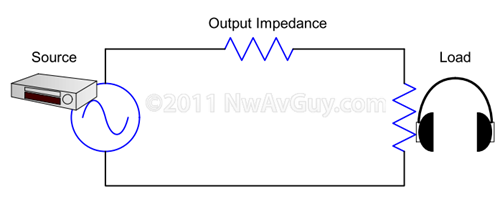
HEADPHONE LOAD IMPEDANCE: This article talks about two different kinds of impedance—the impedance of the headphones (usually easy to find) and the impedance of the source (usually difficult to find). A “perfect” source has an output impedance of zero ohms. This means it will always deliver the same output into any load. In practice, any output impedance below about 1 ohm approximates a “zero ohm” source. The blue circle on the left above represents a “perfect source”, the blue resistor (zig zag line) in the middle represents the output impedance. And the resistor on the right represents the load impedance (the headphones). If the output impedance is not zero, the voltage produced by the source will be reduced when a load is connected. The higher the output impedance, the greater the drop in voltage at the load. This drop is given by the formula: Load Voltage = Source Voltage * ( Load Resistance / ( Load Impedance + Output Impedance) ). For more information see Wikipedia Voltage Divider:

output impedance

R vs Z: Resistance is measured in ohms and represented in electrical engineering by the letter R. It’s typically measured with a DC current and it’s what a Digital Multi-Meter measures. Impedance, however, is more complex and measured with an AC current and the letter Z is the correct representation (but some still use R). Because music is an alternating signal, not DC, impedance is how headphones are rated. Impedance is made up of resistance, capacitance and inductance. Few headphones “look” like perfect resistors—most have significant inductance and at least small amounts of capacitance. They’re what’s known as a reactive load and the math is considerably more complex than just the most basic form of Ohm’s Law.

MEASURING HEADPHONE IMPEDANCE: You can’t measure headphone impedance with a DMM (although many incorrectly try). The more reactive the headphones are, the less accurate the reading will be as the DMM is only measuring the DC resistance “R” not the AC impedance “Z”. The DC resistance will nearly always be lower than the AC impedance. And an AC impedance measurement is only valid at one particular frequency so it’s best to plot if versus frequency in a graph. To do this right requires specialized equipment that can monitor the current and voltage independently over the entire audio band. I use my Prism Sound dScope.

YOUR IMPEDANCE MAY VARY: Virtually all passive headphones (without their own powered electronics) have a varying impedance that changes with frequency. As described above, they don't behave like a simple resistance when driven with typical audio signals. The gold colored graph below shows the impedance, in ohms, of the Ultimate Ears SuperFi 5 Pro in ear monitors. You can see they’re only at their rated 21 ohm impedance below about 200 hz. The impedance rises to nearly 90 ohms at about 1200 hz and drops to below 10 ohms at 11,000 hz:

UE superfi5 free air impedance phase


PHASE: When impedance varies with frequency so will the phase. In this case “phase” is the time difference between the peak voltage and peak current. The greater the phase variation the more “reactive” the load. Generally, the greater the phase shift, the more difficult the load is to properly drive. The white curve above is the phase shift shown in degrees. A simple resistor will have essentially zero phase shift with frequency over the audio band.

HEADPHONE DESIGN COMPROMISES: Drivers, in speakers or headphones, have moving mass. The diaphragm of the driver is suspended in a way that allows it to move. The stiffness of this suspension, the weight of the diaphragm, and sometimes the enclosure it’s in, work together to form a natural resonant frequency. The main resonance in full size headphones is usually in the bass frequencies and most high quality drivers require some sort of damping to control this resonance. If it’s not controlled, it tends to seriously degrade the bass performance of the driver. The impedance peaks at this resonance. Here’s the popular Sennheiser HD280 headphones showing an obvious bass resonance at 75 hz:Sennheiser HD280 Impedance and Phase


WHAT ABOUT TYPICAL EARBUDS? The vast majority of reasonably priced dynamic (not balanced armature) earbuds headphones have a 16 or 32 ohm nominal impedance that might vary by just 1 or 2 ohms. Here's the popular Sony MDR-EX51 which is mostly 17 ohms and rises to 18 ohms at its 5 khz resonance:

Sony MDR-EX51 impedance


HIGH END HEADPHONES: Here’s the 300 ohm Sennheiser HD 650 which vary from about 305 ohms to 530 ohms:

Sennheiser HD650 Impedance & Phase New Open Air_thumb


OTHER RESOURCES: If you missed the links earlier, you might want to check out: