 SOUND QUALITY: The O2 is a small unique headphone amp that compares well in listening tests with much more expensive gear. Are you tired of worrying if you’re getting the best sound from your headphones? Does your iPod or Clip+ fall short with your full size cans? Perhaps the portable amps you’ve tried can’t properly drive your AKG K701s? You might want to keep reading.
THE PROBLEM: I go into more details later but if you look at what’s available in headphone amps it’s not ideal. Very few have credible performance measurements, nearly all the portable models lack enough output for many full size headphones, the Cmoy designs are deeply flawed, many have too high of an output impedance, and the amps that get it right are generally seriously expensive.
THE (nearly) PERFECT HEADPHONE AMP: Wouldn’t it be nice to have a headphone amp that was so quiet you could use it with the most sensitive In Ear Monitors but it also had enough power to drive virtually any full size cans including 600 ohm and current hungry planar models? And, while we’re at it, what if the output impedance was low enough you didn’t have to worry about frequency response or bass damping problems? And, for maximum versatility, what if worked at home on AC power or on-the-go from rechargeable batteries? If you combine all of this with audiophile approved sound quality, switchable gain, great measurements, and a reasonable price, you have something very attractive but also highly elusive unless you’re willing to spend lots of money.
Objective Pitch
 WHAT MATTERS MOST: Most of us want our gear to get out of the way so we can listen to the music as the recording engineer intended. We don’t want to listen to our headphone amp, we want to listen to the music. And if that’s the goal, the path to getting there can be summed up with one word (photo: Jeff Keyzer):
- Accuracy - ak-yer-uh-see: “The condition or quality of being true, correct, or exact”
THE ROAD TO AUDIO NIRVANA: Accuracy, and hence the best sound quality, in a headphone amp is almost entirely determined by (the non-geeks might want to skip this):
- Output Impedance – It should be less than 2 ohms to provide the correct bass damping even with 16 ohm headphones and avoid frequency response problems. Output Impedance differences account for most of the variations in sound quality people hear between different headphone amps and sources.
- Power – Sufficient voltage, current, and gain must be available to drive the desired headphones to realistic levels without strain. Many amps fall short with many headphones.
- Noise – The amp should not contribute any audible noise in real world use. Most, unfortunately have audible hiss—especially when using sensitive IEMs.
- Channel Balance – The stereo image should not audibly shift left or right with any realistic volume setting. This is another common problem.
- Frequency Response – The output should be flat to within +/- 0.1 dB from 20 hz to 20 Khz and not slew rate limited at full power. But many headphone amps, including some fairly big names like Creek and Pro-Ject, use capacitor coupled outputs that roll off the bass into low impedance loads and add distortion. Tube and single ended designs can be even worse.
- Distortion – All non-linearities (unwanted garbage added by the amp) should be under 0.01% (–80 dB) at least at midrange frequencies where the ear is most sensitive, and worst case, under 0.05% (-66 dB) across the rest of the spectrum when operating with the desired headphones and output levels. Singled-ended and tube amps nearly always fail this by a wide margin as do many conventional designs. Ideally an amp should be under 0.01% across the board.
- Transient Response & Stability – Ringing and overshoot should be tightly controlled with all realistic headphone loads. I’ve seen several amps get this wrong in their quest for needless excess bandwidth and/or excessive slew rates.
- Phase response – Less than +/- 2 degrees phase error from 100 hz to 10 Khz assures the best possible imaging and spatial perception.
VERIFIED PERFORMANCE: Unlike 99% of other amps and designs, the O2 design comes with very detailed, and verifiable, performance measurements made using professional instrumentation and industry standards. If you believe in accuracy, and listening to your music instead of your amp, the right measurements help assure you don’t have to worry about the O2 getting in the way of the music.
Subjective Pitch

PASSION, ART & EMOTION: Music is an emotional art form and some argue music reproduction is also an art. They argue there’s more to it than just numbers and science. And, even in my virtual lab coat with virtual pocket protector, I agree. But I think 99% of the art is at the very end of the signal chain—in this case the headphones. There are massive differences in the sound of different headphones. I’ve written about some of them in my HD650 Review. Much like a vintner leaves their personal signature on the wines they produce, so do headphone designers. There’s no such thing as a perfect headphone. They all measure significantly differently. And they all balance the various trade-offs differently. But in a headphone amp, you can get close enough to perfection to where the differences that remain have been demonstrated as entirely inaudible. The O2 is just such an amplifier. (photo: Kay Weller)
LISTENING TEST: The O2 was stacked up against the well regarded $1600 Benchmark DAC1 Pre in a listening challenge. The DAC1 is something of a favorite in the audiophile headphone community. A lot of subjective critics, and those who have measured it, really love it. So it’s all the more satisfying nobody has yet been able to tell the O2 from the DAC1’s headphone amp. The DAC1 Pre earned Stereophile’s top class A rating in the headphone category, a product of the year award, and countless other accolades. It has been described as “stupefyingly good” and “a revelation”. The headphones used in the comparison include the Sennheiser HD650s, Denon AH-D2000s, Etymotic ER-4s, Ultimate Ears SuperFi Pro 5s, and Beyer DT770s. Collectively they cover a wide range of impedance curves, efficiencies, types and subjective tastes in sound. The Denons and Etys are ruthlessly revealing, the HD650s are incredibly musical, the SuperFis ultra efficient, and the Beyers show off performance in the deepest bass. I hope to conduct more listening comparisons involving the O2 and perhaps even a public challenge or two. In short, I’m willing to back up my claims for the O2. Perhaps an O2 listening challenge is in your future?
PRELIMINARY FEEDBACK: Initial feedback from others has been very positive. As of September 2011 there are at least a half dozen or so O2 amps “in the wild” and feedback has been nearly all positive. One user compared the O2 to the $1000+ AMB beta22 using $1000 Audeze LCD-2 headphones and wasn’t sure he could hear any differences.
WHAT DID YOUR CABLES COST? Those who spent more on their cables than the total cost of the O2 may feel compelled to dislike it. It probably won’t matter the O2 likely outperforms whatever they’re listening to now. I’m sure many will expect more expensive, and more “esoteric”, amps to sound better. And, in the usual biased listening, their brain will likely deceive them into hearing just what they expect to hear. Some will probably brand the O2 as “sterile”, for example, because it measures well so their brain will serve up a “sterile sound” when they listen to it. This is an involuntary response (see the brain link above if you don’t believe me and check out Subjective vs Objective). So if you’re a fan of exotic cables and other expensive esoteric solutions to straightforward problems, you can probably stop reading here as you’ll be biased against the O2 from the start and only hear what you want to hear. The O2 is intended for those open to a more objective approach.
A NOTE TO BLING LOVERS: Clearly some people like bling. What their car looks like, or the name badge on the front, can be more important than how it drives. There are plenty of car, and audio manufactures, catering to such tastes. The O2, in basic form, is very big on performance but not so much on bling. To keep the price as low as possible it’s mostly function over form. DIYers, however, are free to make the O2 look as impressive as they like. They can have their high-bling cake and still feast on tasty performance. Slip the O2 into a fancy enclosure, with a big knob, expensive jacks, or whatever else suits your fancy, and nobody needs to know what’s inside.
Going Shopping
 FRUSTRATION: If you look at the headphone amps for sale, nearly all fit into one or more of these categories (photo: FreeAussieStock):
- Missing Specifications - Very few amps have meaningful specs. Things like power output, frequency response, THD and crosstalk are meaningless if the load isn't specified and it almost never is. The output impedance is also a critical spec but is rarely provided. Vague specs are difficult to verify which likely means the manufacture has something to hide, or in some cases, never even properly tested their product. When such amps are properly tested they usually fall seriously short in one or more areas.
- Inadequate Output - Lots of amps, especially portable ones just don't have enough power for many headphones. The relatively popular AKG K701 is a perfect example. Most portable amps, even supposedly "high-end" ones like the AMB Mini3, can't properly drive them.
- High Output Impedance – Lots of otherwise decent amps have output impedances well above the 2 ohm limit. It’s a surprisingly common problem that causes audible frequency response errors and degraded bass performance. See the FiiO E9 review for more and also my Impedance article. Some manufactures raise the output impedance to provide short circuit protection, sometimes for stability reasons, and sometimes to try and mask other design limitations such as low frequency roll off due to capacitor coupled outputs. All the TPA6120 based amps I’m aware of have at least a 10 ohm output impedance (such as the E9 and QRV-09).
- Flavors of Cmoy – Nearly all variations of Cmoy amps suffer major limitations and/or serious problems. Most use op amps that don’t have anywhere near enough current capability for many headphones. And even into higher impedance headphones their distortion can be severe because they’re still not designed to drive anything less than 600 ohms. The dual battery versions can easily damage headphones with high levels of DC. And the single battery versions typically use very weak rail splitters or virtual grounds that further limit the output current and increase distortion.
- Single Battery or DC Wall Adapter Designs – To deliver the best performance a headphone amp needs a dual power supply but many of the more reasonably priced amps cut corners in this critical area. Headphone amps using a single battery, and/or DC wall adapter power supply are limited to using a virtual ground with all the compromises that entails, or capacitor coupled outputs which roll off the bass and add distortion, or a DC-DC converter which tends to add noise to the audio signal. While DC-DC can be made to work reasonably well, it’s mostly found in otherwise compromised amps. The other two options are typically much worse.
- eBay Amp Roulette – Shopping headphone amps on eBay is a minefield of disappointments. A lot of poorly designed amps seem to be “liquidated” on eBay where they’re unlikely to be returned and can be sold anonymously. The Cmoy I tested was a good example—it had no voltage gain. Others have high distortion, poor volume tracking, etc. I’m sure there are some decent amps to be found on eBay but the odds are stacked against you. And eBay is full of knock off products. Even if someone finds a respectable eBay amp, 3 months later it might be gone, badly cloned, or using entirely different parts. This all makes it difficult to recommend most of what’s on eBay.
- Single Ended and/or Limited NFB Amps – While these designs are hard to justify by any objective criteria, some people apparently like their added distortion, or at least buy into the hype. If you’re after the best accuracy, however, you won't find it with any single-ended amp. These amps are sort of like having someone softly murmuring in the background while you’re listening to your music. They often make their presence known rather than getting out of the way. You don’t just listen to the music, you may also forced to listen to the amp due to their higher output impedance, capacitor coupled outputs, and sometimes alarmingly high levels of distortion.
- Tube Amps – Tube amps fit in the same category as Single Ended above but usually with even more obvious flaws. Some like them for nostalgic reasons, and some like to endlessly tweak and modify them, try different tubes, etc. But, ultimately, they’re the opposite of higher accuracy. They can get in the way of your music in obvious ways--especially with more challenging headphones.
- 3 Channel Designs – I’ve shown how the supposed advantages of 3 channel designs are yet another audiophile myth. So far in my testing I’ve only seen disadvantages to 3 channel amps—some rather significant. At best they’re a waste of money and put a lot of unnecessary electronics between you and your music. At their worse they seriously degrade the audio performance. They’re the complete opposite of the monoblock concept and instead sharing lots of distortion inducing circuitry between both channels.
- Expensive – The reputable headphone amps I know of with real bipolar power supplies, suitably low distortion, low output impedance, proper grounding, enough power, etc. tend to be rather expensive. You can buy a decent brand new laptop computer for less than the least expensive amps I know of that meet the criteria. Violectric has some of the least expensive options I know of that provide detailed performance specifications.
STALE AIR: In my experience most headphone amps (and headphone DACs) fail the accuracy, or cost, criteria above. Many have a 10 ohm or higher output impedance (QRV09, FiiO E9) while others lack enough output for popular headphones (FiiO E5, E7, Mini3) And some have excessive distortion (Mini3, NuForce uDAC-2). Some have poor transient response and/or are borderline unstable (QRV09, Mini3). Amazingly, a $39 Cmoy came closest to the above goals but it still had some serious fatal flaws—especially when configured with typical gain and into low impedance loads.
FRESH AIR: The Objective2 a conventional 2 channel amp, with 2 batteries, hence the “2” in the name. But O2 also represents oxygen, and in some ways, this amp is a breath of fresh air. It has none of the limitations listed above. It simply does a very credible job of disappearing from the signal chain leaving just the music as the recording engineering intended. Some might call it “straight wire with gain”. It’s all about accuracy but not in the usual expensive audiophile overkill sort of way.
Motivation
 HOW HARD CAN IT BE? As they say on Top Gear: How hard can it be? Frustrated with commercial offerings that consistently fail with the flaws on the Going Shopping list, I wanted to prove it’s not rocket science to have your cake and eat it too. Unlike Top Gear’s comedic attempts at various challenges, I took a more objective engineering approach to designing my own headphone amp. (photo: anujpradhan.com)
ONE SIZE FITS NEARLY ALL: There are a lot of headphone amps that work well with some headphones but not others. This is especially true for portable amps most of which can’t even drive AKG K701’s properly let alone most of the planar cans. Others have output impedance issues, too much noise for BA IEMs, etc. Rather than take the typical expensive overkill approach, I put on my engineer’s hat and took an objective approach. I established a few worst case hard-to-drive headphones and worked backwards from there (see O2 Design Process). The result is the O2 should comfortably drive most any non-electrostatic headphone your average audiophile would want to use. That includes dynamic, planar/orthodynamic, or balanced armature, from 16 ohms to 600 ohms. The O2 has 2 gain settings to help match it to different sources and headphones. And if your headphones sound better with a higher output impedance, that’s easily accommodated too.
EXOTIC COMPONENT MYTH: The O2 proves you don’t need exotic parts or esoteric circuit designs for best-in-class sound, accuracy and performance. The O2 is a fairly minimalist amp designed around the solid objective goals listed above, not subjective hype or audiophile myths (see: Subjective vs Objective). It doesn’t aim to be “warm” by rolling off the highs, try to be “sweet” by adding a bunch of distortion, or alter the bass via a higher output impedance.
CREDENTIALS CHALLENGED: This article might seem a bit more, um, “enthusiastic” than my usual reviews. And some of that is no doubt personal bias creeping in. But, truth be told, I do have a point to prove. I’ve been attacked for my “lack of credentials” in reviewing other products. It’s funny; when I give something a favorable review my credentials are rarely challenged, but if I’m critical of gear someone owns, I’m suddenly a fraud and can’t be trusted. There’s more on this rather one sided phenomena in the Subjective vs Objective article.
An Open Challenge (two of them)
 MY CRITICS: My critics have said things to the effect of “where’s your amp?” or “what have you designed?” I’ve designed plenty of things, but for various good reasons, they’re not disclosed on this blog. But the O2 is different. It was designed to fill a void in the headphone amp market driven by what I’ve learned about the audiophile headphone community since starting this blog. (photo: Ford Motor Company)
THE OBJECTIVE CHALLENGE: I’ve given my critics what they asked for and hit the ball over the net, so let’s turn the challenge around! Can anyone show me a portable headphone amp that overall objectively performs better for even triple the finished assembled price of the O2? If so, we’ll get someone independent with a real audio analyzer to test both. The O2 should be available for $150 or less fully assembled so I’ll put it up against anything up to $450. May the best amp win!
THE SUBJECTIVE CHALLENGE: Let’s raise the bar even further for all the subjective guys. For any amp that measures sufficiently well into the desired load (reasonably close to the specs outlined in the O2 Design Principals), regardless of cost, I’ll put the O2 up against it with any popular headphones within its drive capabilities. The challenger can pick the other amp, source, music, and headphones. The listening will be done blind using an A/B/X box and the comparison will be recorded on video for publication on YouTube. The test would be administered by an independent third party (I won’t even be present). The results, win or lose, will be published on this blog. And to sweeten the deal still further, if someone beats the O2 in a valid test, I’ll give $500 to the charity of their choice. If they lose, they give $500 to the charity of my choice.
COMPETITION & FAIRNESS: Raising the price/performance bar benefits consumers and that’s all I’m trying to do here. The primary goal of this blog is to get more objective information out there to help those interested better decide how to spend their money on gear. People want to buy things that live up to the manufacture‘s or designer’s claims. I’m trying to encourage manufactures to hopefully publish more and better specs and make sure their products meet those specs when properly measured..
WHERE ARE MANUFACTURE’S MEASUREMENTS? If you’re a manufacture producing a headphone amp, or even a DIY designer promoting your designs, it’s a really good idea to fully measure the performance of any amp to make sure it’s operating correctly, safe for headphones, and performs as intended. If you don’t make the right measurements, you have no idea if you got it right. So if that sort of testing is being done, why do so few manufactures publish any credible test results? It seems you have to spend $650 – $2000 for something like the Benchmark DAC1, Anedio D1, Violectric V90, etc. to get real measurements. If all the other amps perform as well as their creators claim, why can’t they publish some real evidence instead of a couple useless vague “specs”? In my opinion, they’re either not properly tested at all, or the measurements are so poor they don’t want to share them. Neither is very encouraging.
Design Highlights
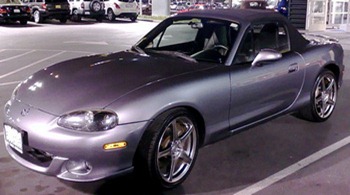
A CASE FOR SIMPLE: Pointless excess is very 2007. Unlike that gold badged Cadillac Escalade that won’t fit in your neighbor’s garage, or some jacked up heatsinked monster headphone amp that looks impressive but falls over when you attempt a tricky corner at speed, the O2 was designed to be lean, mean and perform very well under real world conditions. Think of the O2 as a sort of Mazda MX-5 Miata. The Mazda is a classic design over 20 years old, that’s relatively minimalist, small, light, nimble, well engineered, amazing fun to drive, and very pure. Many find their way onto tracks on the weekend yet serve as a comfortable car for the weekday commute. There’s nothing excessive about it and it’s very reasonably priced for an open roof sports car. The current MX-5 is a lot like the original 1989 model. Mazda has admirably resisted the temptation to mess up near-perfection just trying to be trendy or by adding lots of weight and things people don’t need. It’s the same with the O2. It’s a very pure, honest, small, nimble, amp that is faithful to the music and amazing fun to listen to. And it’s largely based on proven design principals. (photo credit: Agath B)
SIMPLE O2: In the spirit of the MX-5 Miata, the O2 was designed to be as simple as possible. There are no tricky surface mount parts so no special tools or skills are required. To keep shipping costs much lower, and make things easier, all the components except the PCB and enclosure are available from Mouser Electronics in a single order. Most of the parts are very common and nearly all have Mouser substitutes if something is out of stock. There are also part numbers from worldwide distributors like Farnell. The board slips into an inexpensive all aluminum enclosure with no mounting hardware required. All the connectors and openings are along one side and require only round holes in standard drill sizes—no tricky machining required. And, to avoid any metal work completely, just send the supplied file to Front Panel Express for an inexpensive ready made front panel.
TWO BATTERIES BEAT ONE: As explained in my Virtual Grounds article, real grounds work best. The easiest, and most pure, way to a real ground in a portable headphone amp is to use two batteries. It makes the amp a bit bigger, but the single battery options are generally much less attractive and the reviews on this website back that up.
LOW BATTERY HEADPHONE PROTECTION: A significant problem with dual battery designs is what happens if one battery dies first or becomes disconnected. Under those conditions the amp could destroy your headphones with DC. The O2 uses, as far as I know, a novel approach to solving this problem. It shuts the entire amplifier down when either or both batteries start to get low or if one battery becomes disconnected. This not only prevents harmful DC at the output, it also helps protect the rechargeable batteries from being damaged by cell reversal. So with the O2 there’s zero worry about the batteries. You can safely listen until it shuts itself off.
GAIN SWITCH (added 7/24): By popular demand, the O2 now sports a front panel gain switch. This allows more optimal use with different sources and headphones of widely different sensitivities. So you can use your IEMs on the go and your power hungry big cans at home with a flick of a switch. It’s part of the One-Size-Fits-All philosophy.
DESKTOP OR PORTABLE? The default configuration of the O2 is to be as small as possible. This means 3.5 mm mini jacks, everything mounted to the PC board (nothing panel mounted), and using the enclosure shown in the photos. However, for those who want a desktop amp, you can use the next taller case (same width and depth) and the PC board slides in with room to add high quality desktop 1/4” panel-mounted jacks. See: Enclosure Options
The Project
 DIY OR COMMERCIAL? For now the O2 is a DIY project. But see the O2 Details Resources for various options, including fully assembled versions, to get one. And if you’re into DIY, you know the magic of listening to something you made with your own hands. The O2 can provide that magic. (photo: jwyg)
OPEN SOURCE HARDWARE: I don’t want to make any money from the O2. Ever. Like this blog, it’s free and here for those who want it. There are no ads, sponsors, hidden agendas, or online stores. I’m making the O2 design available to everyone under a Creative Commons License.
 This work is licensed under a Creative Commons Attribution-NoDerivs 3.0 Unported License.
THE ARTICLES: This is the first article in a series of three large articles. here’s lot more in the later two articles:
- O2 Design Process – This article covers the design methodology from setting the original goals and requirements through to arriving at more or less the final design.
- O2 Details – This covers everything else including non-DIY options, where to get parts, tips for construction, build options, etc.
- O2 Summary – This is a summary to the other articles and more.
- O2 Op Amp Measurements – Some of the op amp research that went into the O2
The (only slightly biased) Review
 USABILITY: The O2 works pretty much like you’d expect. The batteries are charging any time it’s plugged into AC power--even while using it. It barely gets warm on AC power and not at all on battery. There’s an audible “click” at turn on (most noticeable with sensitive IEMs) and a soft “thump” on power down.
HISS & NOISE: You can’t hear any. Seriously. Even with my ultra sensitive Ultimate Ears SuperFi Pro IEMs, in the quietest room the house, at any volume setting, I couldn’t hear any noise from the O2 itself. Any noise you hear with the O2 will be from the source or an open circuit cable connected to the input. Unlike several other other amps, when you change the volume setting there’s zero noise in the headphones—even with nothing playing.
POWER SOURCE: To geek out for a moment. An often unappreciated parameter of audio circuits is PSRR—Power Supply Rejection Ratio. It’s basically the ability of the circuitry to reject noise, ripple and variations on the power supply. In a lot of discrete designs PSRR is relatively poor and it’s really awful in most single-ended amps. That makes those designs sensitive to even small amounts of noise or variations on their power supply. By comparison, you can listen to the O2 even at full volume on the high gain setting, and attach or disconnect the AC power and there’s zero noise in the headphones. The entire power supply is abruptly jumping up and down by 30% and it’s inaudible! Try that on a single-ended zero feedback and you might damage your headphones the transient at the output will be so large.
BREAK IN: Unlike typical consumer gear, and amps with capacitor coupled outputs, the O2 has no electrolytic caps in the signal path. Electrolytics, in some circumstances, benefit from being powered up a while but that’s not an issue here. So the O2 doesn’t need break-in, warm up, etc. Unlike many fully discrete designs, it’s optimally biased at any sane temperature and the IC’s quickly settle down to their ideal operating points in under a minute.
SUBJECTIVE LISTENING: The O2 is genuinely effortless, totally silent, very spacious, and never breaks a sweat with any headphones I’ve tried. It also works well with any source I’ve tried.
SUBJECTIVE COMPARISONS: I’m more than a little biased, so that’s why I broke out the blind testing gear. And, as near as I and a few others can tell so far, the O2 sounds so similar to the well regarded Benchmark DAC1 Pre’s headphone amp we can’t tell them apart. See The Subjectivist Pitch above. I also believe those currently listening to amps with significant problems, be it higher output impedance, high distortion, audible noise, insufficient power, etc, might be smiling if they try an O2. I’m looking forward to more blind tests.
BATTERY LIFE: The normal version tested here will run 7 - 9 hours and the low power version will roughly match or beat most portable players at 20 - 30 hours depending on the headphones, music, and volume. See: Low Power Version
MEASUREMENT SUMMARY: The most similar portable DIY amp I know of to compare the O2 against is the AMB Mini3 and the O2 outperforms the Mini3 on every test below. Even up against desktop-only amps, like the QRV09 and FiiO E9, the O2 does very well. Most DIY designs have no test results at all or were tested with a soundcard and the many limitations of RMAA. If you read some of my other reviews, you’ll find those RMAA numbers and claimed specs have sometimes proven to be wildly optimistic. I encourage others to verify the O2’s performance. Here’s a summary and comparison and there’s far more detailed results and comparisons in the Tech Section below:
| Measurement | O2 | QRV09 | FiiO E9 | AMB Mini3 |
| Frequency Response | +/- 0.1 dB Excellent | +/- 0.1 dB Excellent | +/- 0.1 dB Excellent | +/- 0.1 dB Excellent |
| THD 1 Khz 150 Ohms | 0.0016% Excellent | 0.002% Excellent | 0.005% Excellent | 0.002% Excellent |
| THD 1 Khz 15 Ohms | 0.0023% Excellent | 0.022% Good | 0.037% Good | 0.017% Good |
| THD 20 hz 15 Ohms | 0.0023% Excellent | 0.07% Good | 0.05% Good | 0.01% Very Good |
| THD 20 Khz 15 Ohms | 0.010% Excellent | 0.02% Very Good | 0.003% Excellent | 0.45% Poor |
| IMD CCIF 15 Ohms | 0.001% Excellent | 0.02% Good | 0.05% Good | 0.043% Fair (2) |
| IMD SMPTE | 0.002% Excellent | 0.0015% Excellent | 0.002% Excellent | 0.009% Very Good |
| Noise (ref 400 mV) | -105 dB Excellent | N/A (1) | -88 dB Fair | -94 dB Excellent |
| Max Output 15 Ohms | 337 mW Excellent | 450 mW Excellent | 1067 mW Excellent | 104 mW Excellent |
| Max Output 33 Ohms | 613 mW Excellent | 640 mW Excellent | 883 mW Excellent | 98 mW Fair |
| Max Output 150 Ohms | 355 mW Excellent | 345 mW Excellent | 317 mW Excellent | 38 mW Fair |
| Output Impedance | 0.54 Ohms Excellent | 10 Ohms Fair | 10 Ohms Fair | 0.9 Ohms Very Good |
| Crosstalk 15 Ohms | 65 dB Excellent | 67 dB Excellent | 63 dB Very Good | 40 dB Poor |
| Channel Balance | 0.6 dB Excellent | N/A (1) | 1.8 dB Fair | 1.14 dB Fair |
| Battery Life | ~8 hours / ~30 hours | AC Only | AC Only | ~5 hours |
- The QRV09 noise and channel balance measurements are not directly comparable, see QRV09 review
- Excessive sidebands, see Mini3 review
FIRST CLASS:
- Excellent measured performance on all tests
- Indistinguishable from Benchmark DAC1 Pre’s headphone output in sound quality
- Works well with nearly all headphones from 16 – 600 ohms
- Very low output impedance for best headphone compatibility
- Front panel switchable gain for best headphone & source compatibility
- Completely silent—no audible noise even with ultra efficient IEMs at any volume setting
- High Output: 7 Volts RMS & 200+ mA peak current
- Current limiting to help protect low impedance headphones from damage
- Unique battery rundown protection prevents battery & headphone damage
- Easier to build with no surface mount components
- Output impedance can be modified on board as desired (DIY)
- No volume control “rustling” (unwanted noise when changing volume settings)
- Optimal star ground and true split bipolar power supply
- Multi-stage design with local feedback improves noise, distortion and stability
- Individual output stages for each channel improves performance
- RF and DC input protection, brief short circuit output protection
- Quality components: 1% metal film resistors, poly film & low ESR caps, Alps volume control
- Fast: Slew Rate 3+ times faster than worst case requirement & bandwidth > ~250 Khz
- Compensated for maximum stability and optimized transient response
ECONOMY:
- Larger than Mini3, E5, E7, and some other portable amps
- Only 3.5mm input and output jacks by default
- Batteries take a while to charge
- Not waterproof to 50 meters
- Metal volume knob is an extra cost upgrade
- Lacks cult status to impress the subjective audio elite
BOTTOM LINE: I think the measurements speak well for the O2’s performance as do the blind listening comparisons to the Benchmark DAC1. The O2 isn’t perfect, but it’s closer to meeting all the goals than anything else I’m aware of for up to several times its price. If there’s any amp I’ve missed, especially a portable one, that can give the O2 a run for its money, please let me know? For those seeking maximum performance for their dollar, the Objective2 is worth considering. And the Creative Commons license opens up commercial possibilities for other people (not me) to profit from it. And if someone accepts my earlier challenge, and does come up with a better amp for the money, then everyone wins. My entire goal was to raise the bar and show what can be done with solid engineering, proper implementation, and cost-optimized components.
WHAT’S NEXT: This article introduces the O2 and documents its performance. I have written a follow up article that addresses the design process while O2 Details covers everything else including links to several other O2 resources and the design documents (schematic, BOM, board layout, etc.). As always, comments and feedback are encouraged.
COMMENTS & FEEDBACK: As I’m banned from Head-Fi I won’t be able to discuss the O2 there. The official threads for this amp are:
- O2 on diyAudio – This is the best place for the DIY crowd to discuss building the O2, creative enclosures, add-ons, etc.
- O2 on ABI – AnythingButiPod is a great friendly site and it’s the best place for non-DIYers to discuss the O2. The more hardcore DIY guys are probably better off at diyAudio.
Measurements (aka Tech Section)

TECH INTRO: In a normal review I would discuss the design details in this section. For this already long article, to keep things manageable, I’m presenting just the measurements. To provide some context, I’ve made many comparisons to the O2’s closest DIY competitor--the Mini3. There are also a few graphs for the FiiO E9, QRV09, and Benchmark DAC1’s headphone output. All the comparative data makes this section longer than normal but hopefully more interesting and useful.
FREQUENCY RESPONSE: The overall response is +/- 0.07 dB from 10 hz to 48 Khz. Both channels are shown into 150 ohms. The O2 has a DC blocking capacitor to reduce the O2’s own DC offset and prevent DC offset at the input from being amplified which could potentially harm headphones. There’s a very slight, and very inaudible low-frequency roll of –.04 dB at 20 hz. The –3 dB point is just above DC at 1.8hz. The O2’s transient response has been optimized using additional compensation which results in the response being down a trivial 0.01 dB at 48 Khz and a – 3 dB point of about 250 Khz. At full volume, the channel matching is excellent (< 0.005 dB):

OUTPUT IMPEDANCE: With 400 mV RMS unloaded a 15 ohm load reduces the output to 386 mV giving an output impedance of 0.54 ohms. This is excellent performance and well under my 2 ohm rule of thumb.
NOISE & VOLUME CONTROLS (and some myth busting): One of the big claims for many audiophile op amps is lower noise. The chip manufactures make a big deal about it and audiophiles, not surprisingly, have jumped on the bandwagon. But, in reality, it’s often the Johnson Noise that limits the noise performance of a headphone amp, not the op amps. Johnson Noise is, literally, self generated noise that’s present in any resistor. The larger the resistor value, the more noise you get. Many DIY headphone amp designs have the volume control at the input to the gain stage. And it’s, at the lowest, usually 10,000 ohms. By comparison the O2 has 274 ohms in series with the input. That’s a huge difference in Johnson Noise. The way volume controls work, the noise is typically worst at half volume where you have 5000 ohms in series with the source and 5000 ohms to ground. So, at typical volume settings, you get a fair amount of Johnson Noise from the volume control that’s amplified by whatever gain your amp has. That noise typically exceeds the op amp’s internal noise. If you put the volume control after the gain stage its Johnson Noise is no longer amplified. And, as a bonus, the volume control at lower settings now attenuates noise from the gain stage. For more, see O2 Circuit Description and Circuit Design.
NEW NOISE REFERENCE: I’ve used 400 mV as my reference level instead of the more typical industry standards of dBV (1 volt RMS) or dBU (775 mV) because a lot of portable gear can’t output anything over 500 mV. But, it’s easy enough to adjust noise figures to different references. So, where applicable, I’m going to to use the industry standard dBV for noise measurements from here forward. To convert dBV to my previous 400 mV dBr values, subtract 8 dB. To convert from 400 mV to dBV just add 8 dB. The dScope reads in dBV directly. It also makes it easier to compare my data to the data published by others.
O2 NOISE: The final version 1.1 O2, using dBV (referenced to 1 V RMS), measures nearly –112 dB unweighted and –115 dB with A-weighting. Referenced to 400 mv that’s –104 dBr and –107 dBr respectively. And note this is at full volume which is the worst case scenario for the O2. This is several dB quieter than even the QRV09 which uses an extremely high end op amp and doesn’t even have a volume control. In fact it’s quieter than any headphone amp I’ve measured:

NOISE AT HALF VOLUME: Most amps, like the Mini3 and E9, have more noise at half volume (due to Johnson Noise) which is a more realistic setting for real world use. The V1.1 O2, however, is actually quieter at half volume. To put these numbers in perspective, referenced to the old 400 mV they’re –105.3 dBr and –108.2 dBr. On the exact same test, at half volume, the Mini3 had nearly 11 dB more noise and measured –94.5 and –97.5 dB. Noise of –113 dB below 1 volt is under 3 microvolts of absolute noise or 0.000003 volts. For more on noise see: Noise and Dynamic Range. The O2 is an extremely quiet headphone amp:
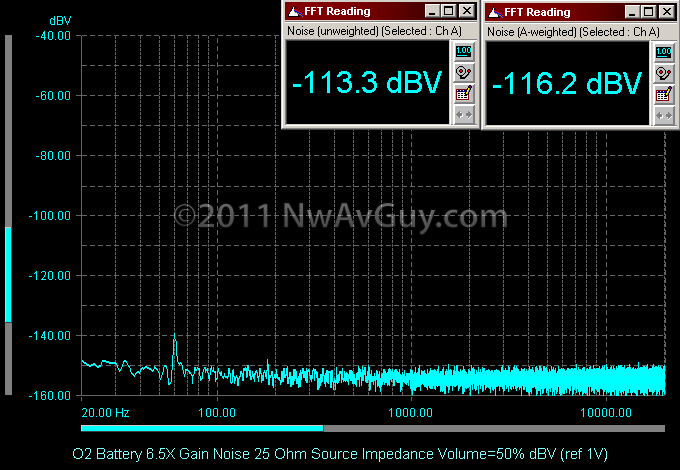
NOISE ON AC POWER: So how does the O2 measure up on AC power? The graph below is the answer—it’s not much different than the battery graphs above:

BENCHMARK DAC1 PRE NOISE: For comparison, here’s the DAC1 at half volume via the analog input referenced to 400 mV so you have to subtract -8 dB and get –108.1 and –113.6 dB. Both about 4 dB more noise than the O2! All the extra noise spikes are due to the digital circuitry, and internal power supply, in the DAC1. I’m sure John Siau and crew at Benchmark Media, however, could match or beat my design if they did a similar analog-only amp with a remote power supply. So this isn’t entirely a fair comparison: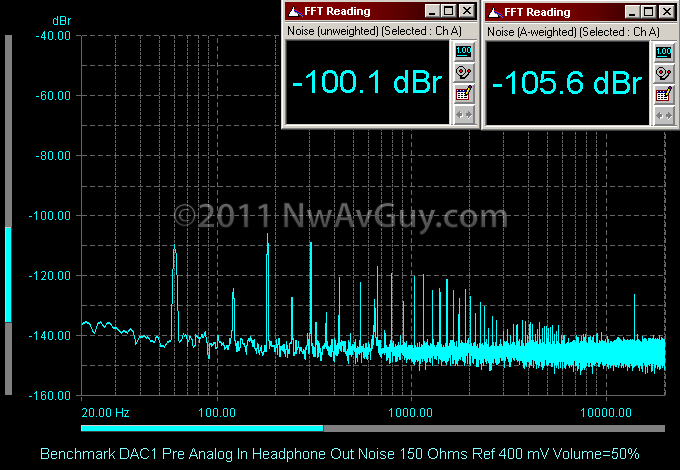
NOISE MARKETING STYLE: The marketing guys usually reference their noise specs to full output. With the O2 that’s around 7 volts. So here’s the exact same test above referenced to 7 volts. The weighted result approaches the –135 dB ultimate noise limit of the dScope! This test demonstrates the O2’s dynamic range:

REAL ENGINEERING vs INTUITIVE DESIGN: Intuitively an amateur designer could easily be excused for believing ultra-low noise expensive op amps are the best way to design a silent amp. But the O2 doesn’t use ultra-anything. This is an example of what I’ve been saying since I started this blog: Implementation is everything and usually far more important than the part number or brand logo on top of the components. The numbers above are a very significant 11 dB better than the Mini3’s more fashionable and more expensive Analog Devices op amp. The difference is in the implementation and design.
THD+N vs OUTPUT & MAX POWER ON AC: At 1 Khz with both channels driven here’s the distortion versus output on AC power into 15, 33, 80, 150 and 600 ohms. At 150 & 600 Ohms the output voltage was essentially the same at about 7.3 volts RMS. And even at about 200 mW of output into any of the loads the distortion is still below about 0.0025%! Maximum power is about 640 mW at 80 ohms. The power limits shown below exceed the power requirements established for the assumed worst case headphones (HiFiMan planars and 600 ohm version of the Beyer DT880):

ACTIVE CURRENT LIMITING: Say you’ve had far too much to drink some evening, you’re listening to your expensive low impedance headphones, and a favorite song starts playing. If you’re listening to one of those “over kill” amps, or even the FiiO E9 that can put out 1 watt, you may well be out several hundred dollars when in your drunken enthusiasm, you crank the volume too high. The O2 tries to prevent such accidents with intelligent current limiting. Instead of throwing a big resistor in series with headphone jack, as many amps do ruining the output impedance, current limiting makes a lot more sense. It allows maintaining a near-zero output impedance and still limits power into lower impedance loads. For those who think it compromises sound quality, the O2 measurements speak for themselves as do the blind listening tests. 166 mA was the target goal to drive nearly any headphone and the O2 doesn’t limit until around 200 mA. So in real world use you won’t get anywhere close to triggering the current limiting. It only comes into play to help protect the output stage and headphones from accidents.
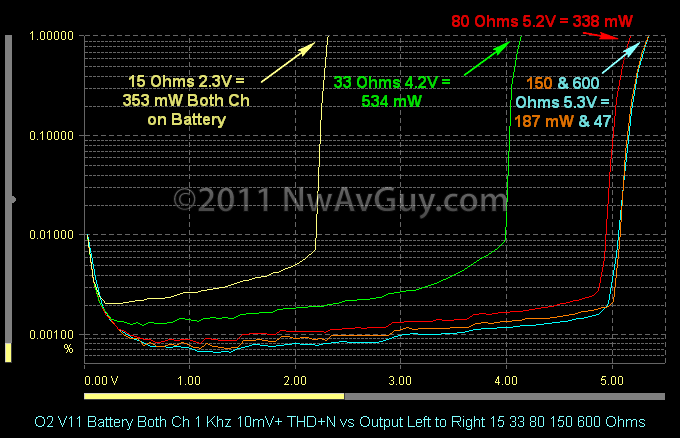
THD+N vs OUTPUT & MAX POWER ON BATTERY: Here’s the O2 running on battery power with both channels driven into 15, 33, 80, 150 and 600 ohm loads. Power is still over 500 mW per channel into 33 ohms for those power hungry planar/orthodynamic cans and the distortion is very similar to the AC performance into all loads (note the horizontal scale is different than above). The power into 15 ohms is roughly the same as on AC due to the current limiting. The batteries were at about 80% charge here (9 volts under load) and the O2 manages +/- 7.5 volts into 600 ohms which is respectably close to the rails. This is the best overall performance I’ve seen from any battery powered amp:
O2 THD+N SWEEP vs AMB MINI3: Here’s both amps at 15 and 150 Ohms running on battery power with the Mini3 shown in pink (15 ohms) and white (150 ohms). Note the O2 produces nearly ten times the power into 150 ohms and over triple the power into 15 ohms. The lack of a shared virtual ground helps the O2 both put out more power and do so at much lower distortion. AMB has said the Mini3 is suitable for 16 ohm loads as long as you don’t “overdrive it”. And the site claims the OPA690 virtual ground can handle 190 mA of current. But even going easy on the Mini3, at only 800 mV of output, it has fifty times more distortion than the O2 (0.1% vs 0.002%). This isn’t “overdriving” the Mini3 as 800 mV is a realistic level many portables can achieve without an amp, and results in only 75 mA per channel of peak current per channel or 150 mA total. This is comfortably within the specs for the OPA690 in the Mini3. If you look at the graph below, at any level into either impedance, the Mini3’s virtual ground is helping making things worse instead of better (note this graph starts at zero instead of 10 mv so the extreme left shows more interpolation error):

THD+N vs FREQUENCY 400 mV: Instead of distortion versus output power above, this is distortion versus frequency across the audio spectrum at a constant 400 mV RMS with the latest V1.1 design. The traces are, top to bottom, 16 (the “16” in the caption is a typo), 33, 80, and 150 ohms. At 150 ohms you can see the distortion is generally extremely low around 0.0009% across most of the band and essentially flat with frequency. 80 ohms is almost identical. At 33 ohms, the distortion is still only about 0.0015% across the band. And into a difficult 15 ohms the distortion is still around 0.003% – 0.004%. The NJM4556 is really showing off here. This is amazing performance for a $0.60 IC into 15 ohms! The THD bandwidth is limited to the audible range (22 Khz) as that’s the industry standard. This causes the traces to drop at the top end where arguably inaudible ultrasonic harmonics are filtered out by the analyzer:
WIDEBAND THD+N SWEEP: Some have asked what happens if you remove the 22 Khz bandwidth limit of the audio analyzer to let the ultrasonic harmonics be included in the measurement. Here’s the above test repeated, at 80 ohms, but at the full bandwidth of the analyzer (192 Khz sampling). The overall distortion is slightly higher as that’s really the higher “noise floor” from the analyzer adding in all the noise above 22 Khz. Still, the distortion barely crosses 0.002% at 20 Khz:

THD+N vs FREQUENCY 6.0 Vrms: Ok, the O2 looks good at my standard level of 400 mV for this test, but what about pushing it to nearly the limit at 6 volts RMS? There are not many (any?) headphones under 150 ohms that need that much voltage. Into 150 ohms the O2 is putting out 250 mW per channel or half a watt with both channels. Even at this hefty power level the distortion is still below 0.002% across the entire band:

FiiO E9 THD SWEEP COMPARISON: Here’s the O2 vs the FiiO E9. Into 150 Ohms they’re both good but the O2 has about half the distortion of the TPA6120-based E9 across the entire spectrum. Into 15 ohms the O2 kills the FiiO E9 below about 4 Khz. The O2 is the clear winner here:

BENCHMARK THD COMPARISON: Here’s the Benchmark at only 15 ohms as any higher impedance is about the same. That’s because, at 400 mV, noise dominates the THD+N measurement on the DAC1, not distortion. Regardless, the O2’s performance is very much in the same league with both below 0.003% in either either load across the band:

THD+N 150 OHMS WIDE SPECTRUM: Here’s the wideband THD+N measured to 80 Khz, both channels into 150 ohms at 400 mV on AC power. THD+N of 0.0016% is excellent and slightly lower than the expensive op amp in the Mini3 managed. The worst distortion product is below an impressive –108 dB. Note the THD+N is nearly identical in both channels. This indicates the PCB layout is electrically symmetrical. The –115 dB spike at 60 hz is also very inaudible. The readings and spectrum in this test are so similar on AC and battery it’s hard to tell them apart. There’s nothing to fault here:

BENCHMARK COMPARISON: Here’s the DAC1 for comparison with the same test as above. It has about twice as much THD+N but most of it is just noise from all the nearby digital circuitry not actual distortion:

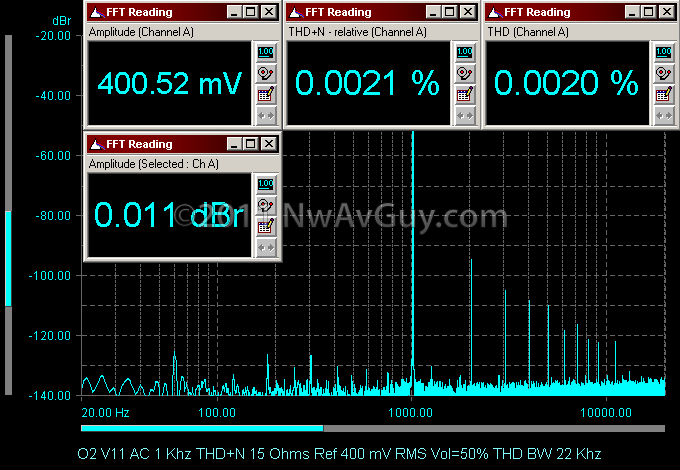
LOW LEVEL THD & THD+N: The THD+N vs output sweeps above make it look like the O2 has lots of distortion at low levels. But that’s not the case. The sweep points are averaged and interpolated. And because the sweep is starting at zero volts where the THD+N is essentially 100% (all noise no signal) it skews the result into looking worse than it really is. Here’s the THD+N and THD readings at the same 1 Khz referenced to the same 400 mV but with the amp only putting out 10 mV to simulate low level listening. Note the THD reading is only 0.0019%. Everything else that goes into the 0.03% THD+N reading is just noise which, relatively, is a much greater portion of the measurement when the signal is this low. This is excellent performance:

THD+N 15 OHMS SPECTRUM: A lot of amps struggle with this test as it’s a much more challenging 15 ohm load. But the O2 aces it with everything well below an impressive –94 dB. The Mini3, in comparison, failed with the 3rd harmonic at about –75 dB. The THD+N and THD readings are nearly the same because the noise floor is so low:

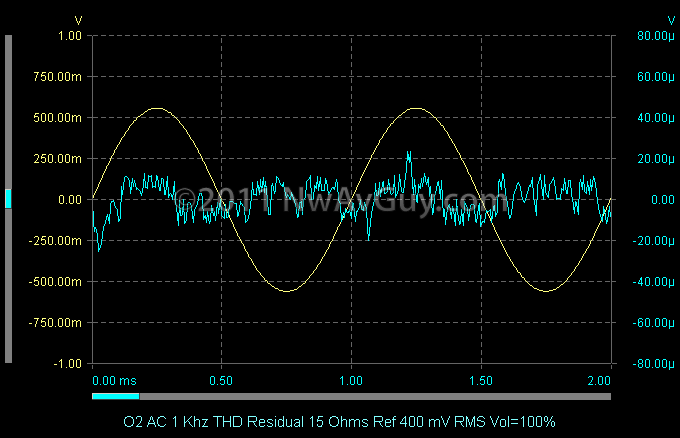
THD RESIDUAL 15 OHMS: The main idea behind power hungry Class-A amps is to get rid of a particularly objectionable form of distortion known as crossover distortion. Crossover distortion shows up in this test as an obvious large spike or “glitch” in the blue waveform where the yellow waveform crosses through zero (see the Mini3 for an example). It’s very common, and sometimes rather severe, in headphone amps that use discrete output transistors unless it’s a true class-A design. This is the best of both worlds. Class-A performance with zero visible crossover distortion on a Class-B power budget even into a challenging 15 ohms and less than 7 uV RMS of distortion residual:
INPUT OVERLOAD ON BATTERY – Here’s the V1.1 O2 running on batteries at about 80% charge. The battery voltage was 9.2V. At 2.5X gain it can still handle a 2 volt RMS input signal, which is the Redbook standard for home digital audio equipment. On AC power it can handle 2.8 V RMS which is well in excess of the FiiO E9 which overloads at 2.1V input. So even on reasonably charged batteries the O2 is fine on battery power:

INPUT OVERLOAD ON AC – Here’s the V1.1 O2 running on AC power with 2.9 V RMS in at 2.5X gain and half volume. The uniform distortion products are a sign the input stage is just under clipping but the THD+N is still a respectable 0.0074% and everything is way under the magic –80 dB point:

VOLUME CONTROL MYTH BUSTING: While the volume setting can make a difference, mostly with noise measurements, it’s usually not the dominant factor in most amplifier performance tests—especially at 1 Khz or below. Some of my critics argued my Mini3 review was flawed because I used a volume setting of 50%. So here’s the exact same test as earlier, repeated with the volume set to 50% and the input signal raised to get the same 400 mV at the output. The distortion actually went down by an insignificant amount (likely in part due to lower noise). In other words, it’s virtually the same if not better at 50%. Another myth busted:
THD 20 KHZ 150 OHMS: With the volume at 50%, here’s the 20 Khz result measured out to 88 Khz. Note the worst distortion product is about –93 dB. This is excellent performance (the V1.0 and V1.1 boards tested the same):
THD 20 KHZ 15 OHMS: 15 ohms at 20 Khz with a THD measurement bandwidth out to 88 Khz is genuinely challenging and includes the ultrasonic region. And the O2 still does very well barely staying under the magic –80 dB mark across the board. By comparison, despite the realistic level of only 400 mV, the Mini3 did very poorly on this test with a reading of 0.45%—or 27 times more distortion. The FiiO E7 was also higher at 0.056%. The O2 is edged out here by the QRV09 which rocked this test with 0.003%. The TPA6120 in the QRV09 does a great job at high frequencies into low impedance loads. But, the TPA6120 (also used in the FiiO E9) has other problems as seen earlier in the sweep comparison. There’s also theTI mandated 10 ohm minimum output impedance. The O2 has zero audible problems here (the V1.0 and V1.1 boards tested the same):

THD 20 HZ 15 OHMS: I skipped the 150 Ohms 20 hz test as it approached the noise floor of the dScope itself. But at a challenging 15 ohms at least there’s something to see even if it only adds up to 0.0023% THD+N. Everything here is well below –90 dB. For comparison, the QRV09 and E9 di much worse here with about 30 times more distortion than the O2. The Mini3 came in at 0.01%—about 4 times higher. This is excellent performance (the V1.0 and V1.1 boards tested the same):

IMD CCIF 150 OHMS: Many think this is a more revealing test than simple high frequency THD. Some amps really make a mess of it and create a lot of distortion products within the audible band. Like nearly all my tests, this one is run with both channels driven at 400 mV. As with the other tests, you ideally want everything but the two signals (at 19 Khz and 20 Khz) below –80 dB (or –66 dB depending). The O2 does far better with everything in the audio band below about –102 dB including the sidebands (the V1.0 and V1.1 boards tested the same):

IMD CCIF 15 OHMS: This is one of the most challenging tests I run. Every single amp and device so far has failed the “-80 dB rule” with something over that level. The Mini3 had a very difficult time with this test as did the uDac-2. Even the TPA6120 QRV09 and FiiO E9 had the 1 Khz component, right where the ear is most sensitive, well over –80 dB. In comparison, the O2 passes this tough test with flying colors. Even the ultrasonic components are below –80 dB (the V1.0 and V1.1 boards tested the same):

MINI3 IMD CCIF 15 OHMS: To put the above performance in perspective, here’s the Mini3 on the same test, same 400 mV, same load. Notice the sideband that reach almost –50 dB. These are almost certainly audible:

IMD SMPTE 150 OHMS: Not much to see here. Everything is below about –110 dB:

IMD SMPTE 15 OHMS: This is also a very good result with everything below –90 dB. The QRV09 and E9 both crossed the –80 dB line on this test and the Mini3’s reading was about 4 times higher (the V1.0 and V1.1 boards tested the same):

INTERCHANNEL IMD BASELINE: While testing the Mini3 I found its shared virtual ground (“3rd channel”) was causing a lot of problems. I devised a test to show some of these problems more clearly. I operated the measured channel at 1 Khz and the other channel at 300 hz with both at 1 volt into 15 ohms. Even though the combined peak current was within the claimed current capabilities of the shared virtual ground, it created a “forest” of ugly relatively high level distortion products. First, here’s the O2 with one channel driven into 15 ohms at the same 1 volt. This is the baseline and the residual noise figure of –100.5 dB (which excludes the 1 Khz signal and its harmonics) shows there isn’t much else going on (the V1.0 and V1.1 boards tested the same):

INTERCHANNEL IMD: Here’s the same test but now the other (unseen) channel is also driven to 1 volt into 15 ohms but at 300 hz—a different frequency in each channel. There’s the expected 300 hz signal at –64 dB which is the expected crosstalk into 15 ohms (more on that below). But the important thing to note is the rest of the spectrum isn’t much different than the one above. The residual noise figure, which is the sum of everything not related to the 1 Khz signal, reflects only the expected crosstalk at 300 hz. The two different signals don’t interact in ugly ways via the common virtual ground like they do in the Mini3. There’s virtually no extra non-linearities here. This is important as there are good reasons to believe non-linear interchannel distortion could be much more audible that the usual variety. This is explained more in the Mini3 review and 3 Channel articles. This result is also important to prove a point. I’m still getting messages from people defending 3 channel designs as being objectively better. So there’s a bit of an axe to grind here. The main premise for 3 channel designs is the headphone currents (which are relatively high here at about 94 mA peak per channel) “pollute” the power supply rails and the input ground circuitry. Some have shown scary looking simulations, talked about power supply capacitor ESR, etc. This is a class B amp. So all those non-linear currents should be “polluting” the O2 and causing problems if you buy into the 3 channel argument. But that’s not the case. If the alleged “pollution” were a real world problem there would be a much bigger mess in the graph below. The only significant “leakage” is the linear (not a form of distortion) crosstalk from the other channel and that’s the fault of the headphone jack, not the real ground. With a 4 wire headphone connection it would be more like –95 dB. These results, and everything else I’ve shown, hopefully put the 3 channel myth to rest. It’s based on a false premise that’s best addressed with a proper star ground. And, regardless, the much greater negative side effects of a virtual ground far outweigh any supposed benefits. Here’s yet more evidence (also see the Cmoy review):

MINI3 INTERCHANNEL IMD COMPARISON: Here’s the exact same test on the Mini3. Note the “forest” of non-linear distortion products created by the virtual ground amp:

CHANNEL SEPARATION (CROSSTALK): This has been another bone of contention with the 3 channel fans. The claim is a virtual ground makes for lower (better) crosstalk but that’s not what I measured on the Mini3 and in fact it’s also not what basic circuit theory would predict. AMB claims a measured –88 dB crosstalk at 33 ohms for the Mini3. But I’ve provided the math (see the Mini3 review) showing that would require a ground impedance of only 1.3 milliohms (0.0013 ohms) which is, for many reasons, quite impossible. I measured –46 dB at 33 ohms for the Mini3 which has since been verified by a former Mini3 fan. It’s the Mini3’s actual crosstalk and mainly the virtual ground is responsible for the poor result. By comparison, using a real star ground, the O2 measures a much better –72 dB (below) at 33 ohms. And that’s almost entirely caused by the 3.5 mm jack and plug. It would be better than –95 dB (at 1 Khz) using a 4 wire connection. The O2’s crosstalk, top to bottom, at 15, 33, 150 and 600 ohms is shown below. At 1 Khz, with the volume at 100%, the O2 measured about –65 dB, –72 dB, –91 dB and –95 dB respectively. This is similar to the also excellent QRV09 which didn’t even have a volume control. At 600 ohms, above about 5 Khz, you can see other aspects of the design besides the output ground impedance contributing to the crosstalk. This is literally as good as it gets with a typical 3.5 mm jack and plug:

CHANNEL SEPARATION (CROSSTALK) VOLUME=50%: Part of the Mini3 crosstalk debate centered around the volume control setting. My critics claimed the Mini3’s crosstalk would have met AMB’s claims at full volume. So to show what effect the volume control has, here’s the O2 at half volume (yellow) and full volume (blue) into 150 ohms: At 1 Khz the volume control degrades the crosstalk only 2.4 dB to –88.9 dB. Note how the performance below 1 Khz is virtually identical. Above 1 Khz the capacitive coupling between the left and right sections of the volume control (and to some degree other parts of the circuit) increasingly affects the measurement. With the Mini3, the crosstalk was poor all the way down to 5 hz. The O2’s crosstalk, at any frequency, is around 20 dB better than Mini3 with both at the same 50% volume setting. So on a completely level playing field, even into a virtual-ground-friendly 150 ohms, at only 400 mV of output, the virtual ground is inferior by a wide margin. It’s an apples-to-apples comparison and I’m not even remotely “overdriving” the Mini3. This is just the advantage of a real ground compared to using an op amp as a common ground. Please see the Mini3 review and comments for the math if you’re still in doubt (the V1.0 and V1.1 boards tested the same):
PHASE: The O2 provides correct absolute phase (it does not invert the signal). The phase response may not be as ruler flat as some amps I’ve tested, but that’s by design. The O2 has DC protection and better transient response as a result. It’s off by less than 0.8 degrees at 10 Khz and about the same amount at 100 hz. This means the phase is extremely accurate through the bulk of the audio spectrum containing spatial information. There’s very little spatial information below 100 hz and 5 degrees at 20 hz is still trivial and better than the 8 degrees of the QRV09. The low frequency phase shift is from the –3db point of 1.8 hz using the largest value high quality film capacitor that would fit in the small enclosure rather than an inferior (but higher value) electrolytic. Above 10 Khz the rest of the signal chain, especially the DAC output filter, probably has a much larger phase shift than the O2. The very slight HF shift in the O2 is from the added compensation and transient optimization (-3 dB at ~250 Khz):

ADJUSTABLE GAIN: The default low gain setting for the O2 is ~2.5X (~8 dB) for use with typical headphones and/or high output home sources. And at the high gain setting it’s ~6.5X (~16 dB) for low output sources or high impedance headphones needing lots of voltage. See Gain Settings and All About Gain. The graph below shows the final V1.1 O2 at the default gains. You can see there’s only a very slight increase in distortion switching to 6.5X gain part of which is likely just the noise floor:

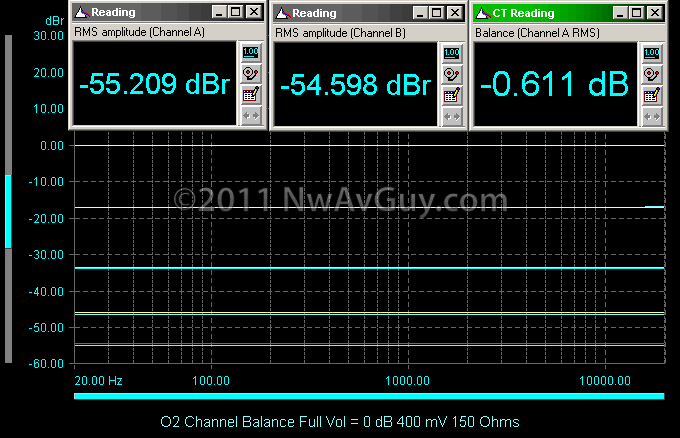
CHANNEL BALANCE: The O2’s Alps volume pot, which is essentially the same one used in the Benchmark DAC1, tracks impressively well. I usually only measure down to –45 dB (shown in the graph) as below that things tend to get ugly. But here the O2 is still well under 1 dB error even at –55 dB (which is really quiet for any sane gain configuration)! Note this is the “3B” taper which should score worse for low level channel balance. For comparison, the FiiO E9 has 1.8 dB of error at –45 dB:
CLIPPING PERFORMANCE: Some amps become unstable when pushed to clipping for many reasons. Some op amps, for example, are prone to phase reversal when clipped where the output violently slams into the opposite supply rail. Other amps exhibit ultrasonic oscillation when clipped. The O2 is completely clean into any load I tried and also exhibits very close to symmetrical clipping. This is one of those tests everyone should always run, and not just with a soundcard “scope”, so you can see any ultrasonic/RF problems. Here the O2 hits +/- 20 volts peak-to-peak at 10 Khz into 600 ohms on AC power on a 100 Mhz scope:

SQUARE WAVE PERFORMANCE: Here’s a 2 volt p-p 10 Khz square wave into real world Sennheiser CX300 headphones. Note the complete lack of overshoot or ringing and the relatively square edges of the waveform. This is due to the dominant pole compensation being optimized for the best transient response. The little bits of noise on the horizontal parts of the waveform is noise from the 2 GS/sec 8 bit A/D in the scope not the O2:
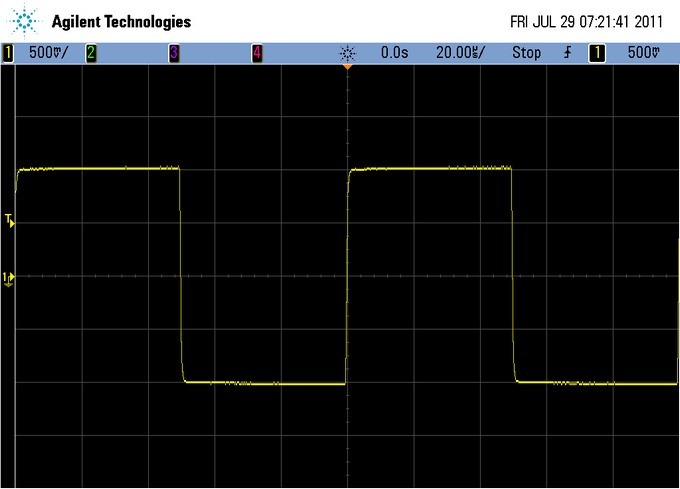
CAPACITIVE LOAD STABILITY: Here’s the exact same test as above, but with an added 0.01 uF of capacitance (headphones + capacitor in parallel). Note the rise time is slightly slower but it’s otherwise completely stable with no overshoot or ringing:

SLEW RATE: Here’s a greatly “zoomed in” view of the same 10 Khz square wave but this time into 600 ohms at just under clipping. This is on a different scope that’s useful because it gives the difference in voltage and time for any two arbitrary points on the waveform. In the last column of the measurements at the top you can see between points 1 and 2 on the waveform it covered 12.65 volts in 3.51 uS. This gives a slew rate of 3.6 V/uS. By the industry rule of thumb, the O2 only needs a slew rate of 1.4 V/uS and the spec generously calls out 3 V uS. So, bottom line, this amp will never slew rate limit, even at full output, with any digital music you can feed it. There can be ugly side effects associated with excess slew rate. The megahertz region instability seen on the Mini3 with this same test is likely just such a side effect.
SQUARE WAVE RISE TIME: This is essentially the same test as above, same 20 V p-p, same 600 ohms, but on my Agilent scope which does the industry standard risetime calculation using the 10% and 90% points on the waveform. So the signal went from –8 volts to + 8 volts in 4.6 uS which gives a 3.5 V/uS full power slew rate very similar to the 3.6 V/uS measured above:

DC OFFSET: The V1.0 DC offset measures 2.8 mV in one channel and 2.7 mV in the other which is insignificant. The V1.1 board measured 3.0 mV and 3.1 mV.
THE FINE PRINT: Unless otherwise specified all tests are the default configuration at 2.5X gain, with both channels driven into the specified load at 50% volume. Most graphs indicate “AC” or “Batt” documenting the power source used. The WAU16-400 wall adapter was used for the AC tests and Nexcell 200 mAH “EnergyOn” (V1.0) and Tenergy 200 mAH and 250 mAH (V1.1) 8.4 V NiMH batteries were used for the battery tests. Maximum power output in the battery powered tests varies a bit due to battery charge level and the different batteries. The driving source and measurement instrument, unless otherwise noted, was a Prism Sound dScope III running V1.4d software. The dScope’s output impedance is 25 ohms. For more on my measurements, please see Testing Methods.
VERIFICATION OF MEASUREMENTS: I’m hoping to have the O2’s more critical measurements verified by someone independent with an Audio Precision, dScope, or similar equipment. If there are any measurements anyone is especially suspicious of, please let me know so I can make sure they are verified.
TECH SECTION SUMMARY: I won’t keep repeating myself except to say I’m very pleased with the O2’s measurements and I’m not aware of any portable amp, especially with the O2’s output voltage and current capability, that can beat it at for anywhere even close to the price. The next article covers the design process while the O2 Details covers everything else. It’s a lot to read but hopefully the headings will help folks skip the stuff they don’t really care about.

This work is licensed under a
Creative Commons Attribution-NoDerivs 3.0 Unported License.


